SRHE Blog

The Society for Research into Higher Education


Leave a comment

In defence of SoTL: anchoring educational evaluation and educational research

by Liz Austen

By the end of 2025 I had attended three HE related conferences: Euro SoTL, the Wonkhe Festival of HE and the SRHE Annual Conference. I presented on similar topics at all three events; what evidence do we generate to help us understand and act to enhance student experiences and outcomes in higher education? During the Wonkhe panel and my SRHE session, I defined two approaches at the disposal of HE practitioners:

Higher Education Evaluation: an approach which helps to understand and explore what works and doesn’t work in a given context and is of value to stakeholders. The aim of evaluation is to generate actionable evidence-informed learning, which encourages, informs and supports continuous improvement of process and impact (Evaluation Collective 2025)

Higher Education Research: to extend knowledge and understanding in all areas of educational activity and from a wide range of perspectives, including those of learners, educators, policymakers and the public (adapted from BERA, 2024)

At the Wonkhe panel, Clare Loughlin-Chow (CEO of SRHE) helpfully outlined the higher education research topics that were most prevalent in the SRHE journals. Omar Khan (CEO of TASO) then outlined the scope and priories of TASO, an affiliate member of the government’s What Works Network which focuses on higher education evaluation. My conceptual discussion of evidence generation brought the two together.

At EuroSoTL earlier in the year, my colleagues and I outlined our new institutional approach to the Scholarship of Teaching and Learning:

Scholarship of Teaching and Learning (SoTL): to improve student learning through engagement in the existing knowledge of teaching and learning, developing contextual ideas and innovation in practice, reflecting on practice, applying methodological rigour, working in partnership with students, and sharing of scholarship publicly (adapted from Felton (2013))

When I attended SRHE in December 2025, SoTL appeared in only one session I attended and some of this discussion focused on the challenges of bringing SoTL into spaces for educational research. My hand in the air comment – that criticism of SoTL by educational researchers was an example of ‘academic snobbery’ – certainly raised a few eyebrows. This blog post considers the relationship between these three approaches and whether, for the good of our students, it’s time for some reconciliation.

Educational evaluation, SoTL and educational research

Educational research in higher education has developed over the last 60 years. Interestingly, research into teaching and learning is cited as the most theorised by this type of research (Tight, 2012). Higher education evaluation, sometimes considered as applied research, was recently propelled by the Office for Students’ agenda to ‘evaluate, evaluate, evaluate (Office for Students, 2022). SoTL has developed alongside HE research and evaluation, emerging from Boyer’s work in 1990.

The aims of each endeavour are distinct, tied by the notion of ‘enquiry’. Research seeks to build new knowledge, and evaluation seeks to provide judgment on a contextual problem. SoTL has a narrower focus on teaching and learning than the broader scope of research and evaluation but incorporates prior knowledge and contextual problem solving through focused enquiry (Gray, 2025). SoTL builds on the foundation of social sciences methodology and can integrate disciplinary methodology into practitioner’s teaching and learning enquiry (Riddell, 2026). Educational evaluation often asks questions of the effectiveness of interventions, but in some teaching and learning spaces, the evaluative language of ‘intervention’ isn’t appropriate (Austen (2025) in Austen and McCaig (2025)). Exploring what works through SoTL enquiry aligns better. Often the bridging term ‘pedagogic research’ is used as integral to SoTL (close to practice) but distinct from educational research (broader anticipated impact). Our chosen SoTL definition uses neither research nor evaluation terminology, but has component parts – knowledge, innovation, method, dissemination – that are central to all.

The essential agents in educational research, evaluation and SoTL are the same – individual students (as partners, as participants and as voice givers), individual staff (academic and professional services), institutional groups or clusters, collaborating HEIs, and third space organisations. Reasons for enquiry are also similar and include sector expectations and shared learning, the desire for institutional enhancement and impact, personal development and career progression. Or as Ashwin & Trigwell (in Evans et al, 2021) note:  to inform a wider audience; to inform a group within context; to inform oneself. All research, evaluation and SoTL agents must navigate the practical and ethical considerations of ‘insider’ enquiry if they are exploring their own practices or within their institutional contexts (BERA, 2018; Barnett & Camfield, 2016).

Output pathways are also interconnected. The SoTL staircase (Beckingham, 2023) recognised the variety of outputs encouraged by SoTL and includes those traditionally aligned with research and evaluation (reports and journal articles). Research outputs may be guided by REF criteria, and evaluation outputs by readership. The conclusions in research articles frequently state that more research needed, and evaluation reports often sit unread in metaphorical desk draws. In comparison, SoTL practitioners benefit from publications which are close to practice, quicker to publish, and more likely to influence change.

Both educational evaluation and educational research are inherently theoretical, grounded by educational or pedagogic theory or a theory of change. SoTL is more action focused, less theoretical than research yet can be more exploratory than evaluation. In 2011, Kanuka questioned SoTL’s credibility due to the lack of theoretical underpinning or reference to existing scholarship. At times, I suggest that educational research can be positioned too far in the opposite direction. The presentations at SRHE were heavily theoretical and sometimes I was left thinking ‘so how would this work actually improve the learning experiences of students’? In contrast, the breadth of SoTL includes both theory and action, albeit in more pragmatic ways.

There are values and specific skill sets of educational researchers and evaluators (and often epistemological disagreements occur between the two). This commitment to identity can be excluding and may help to understand why SoTL has been challenged. Canning & Masika (2022) caution us on the ‘threat to serious scholarship’ posed by SoTL, which they believe risks devaluing research into higher education learning and teaching. Their criticism of ‘anything goes’ I would frame as an important approach to inclusion. Their criticism of the ‘watered-down version of teaching and learning research’ I frame as SoTL’s recognition of the developmental, particularly in building staff confidence. Where confusion over definitions and scope still occur, I question whether institutional SoTL has been well grounded or well led.

Conclusion

There is clearly a divide between higher education research and SoTL. There are few recent SRHE blog posts which reference SoTL at all and one that does advises against flag-in-the-sand nomenclature (Sheridan, 2019). Having spent a lot of time in these circles, I believe higher education evaluators are more agnostic, but I include them in this discussion as they bring a new dynamic to this debate.

In this blog I have identified the ways in which research, evaluation and SoTL have their own agendas and yet have much in common. I argue that SoTL emerges as a grounding anchor between higher education research and higher education evaluation. SoTL borrows from both. SoTL feeds into both. SoTL is more than both (Potter, 2025). SoTL’s inherent value is the ability to build a community which improves student experiences and outcomes in an enquiry led and timely way.

For more details on the approach to SoTL at Sheffield Hallam University see: https://lta.shu.ac.uk/scholarship

Reference

Riddell, J (2026) ‘Hope circuits in practice: how the scholarship of teaching and learning fuels pedagogical courage and systemic change’ Guest Lecture, Sheffield Hallam University

Liz Austen is Professor of Higher Education Evaluation and Associate Dean Learning, Teaching and Student Success at Sheffield Hallam University. She has worked as an independent Evaluation Consultant on HE sector contracts and is a regular keynote speaker on all things evaluation in HE. Her focus is on evidence informed practice across the student lifecycle. Liz also leads a cross sector HE network called the Evaluation Collective.


Leave a comment

Can folk pedagogies help us understand the limited impact of research on higher education?

by Alex Buckley

The SRHE conference is a great place to see our field in all its glory. From the sessions I attended in December 2025, one thing that was abundantly clear was the desire of so many HE researchers to change the world. A distinctive feature of contemporary HE research – reflecting the social sciences more broadly – is the focus on political and ethical issues, with avowedly political and ethical intentions. The improvement of society is often the explicit end, rather than the more humble improvement of our own part of the education system.

Despite this desire to make a difference, higher education research has for many years been held up as an area where the impact of those working in the field is not what it could be. As George Keller said in 1985, “hardly anyone in higher education pays attention to the research and scholarship about higher education”,

Asking the right questions?

There hasn’t been a lot of work on the gap between research and practice in HE – though there is a fair amount in the schools sector from which we can extrapolate, to a greater or lesser extent – but one issue that has received some attention is the fundamental one: are researchers actually asking the right questions?

Vivianne Robinson is a researcher who has laid a substantial amount of blame at the feet of researchers, who “have little to offer by way of alternative solutions, when the problems they have been studying are not those of the practitioner” (Robinson 1993). I have recently used Robinson’s model of Problem-Based Methodology to explore whether research about exams in higher education does engage sufficiently with the challenges that teachers take themselves to face. The results were not encouraging.

One of the more straightforward of Robinson’s criteria for impactful research is that researchers should be addressing teachers’ beliefs, and correcting them where they are erroneous. That’s important, but what if those beliefs are hard to shift? We all have stubborn hunches about how higher education works: good ways of motivating students, how to write feedback that will make students pay attention, how to clearly communicate complex ideas. What if there are teacher beliefs that are deeply embedded, so deeply that we don’t always know we have them, but that aren’t helping us and need to change?

One idea that has been explored in the school sector, but has largely passed us by, is the concept of ‘folk pedagogies’. This idea was developed in the 1990s as an extension of the more famous concept of ‘folk psychologies’: the tacit theories that we all have that allow us to make sense of people’s behaviour. For Jerome Bruner, a natural next step from folk psychologies was the idea that we have intuitive theories about how people learn.

“Watch any mother, any teacher, even any babysitter with a child and you’ll be struck by how much of what they do is steered by notions of ‘what children’s mind are like and how to help them learn,’ even though they may not be able to verbalise their pedagogical principles.” Bruner (1996)

There has been some research in the school sector about the implications of this idea, particularly in terms of how much difference research makes to educational practice. Folk pedagogies have two features that will make them a factor in the impact of education research: they interfere with the uptake of new research-based ideas and approaches, and they are stubborn. On the first point, the idea is that new ideas about higher education will have to replace the old if they are to influence teachers; and on the second, evidence suggests that even where trainee teachers have ostensibly internalised more scientific theories of learning, the folk pedagogies come creeping back.

In the case of higher education, what might these commonsense, intuitive theories look like? They might just be very general ideas about how people learn, applied to the particular context of higher education. Bruner identifies a range of broad folk pedagogical views, such as one which sees ‘children as knowers’, with a focus on the gathering and organising of facts. Perhaps one kind of folk psychology of higher education would be the application of that idea specifically to students in universities rather than other sectors: a focus on the selection, organisation and retention of propositional knowledge within degree programmes. Perhaps there are also specific intuitive theories about higher education that influence teachers’ practices. Perhaps there is a folk intuition that university students should not be spoon-fed – that they must take responsibility for their own learning and seek to develop their own views. Perhaps there is a folk intuition that students should encounter challenging views that encourage them to question their own certainties. In the absence of research, we can only speculate (and introspect).

Respecting the ‘folk’

The idea that teachers have deep intuitions about how students learn, that those intuitions can prevent them from acting on more evidence-based beliefs, and that those intuitions are hard to shake; none of those ideas are particularly earth-shattering. They are probably common sense among those researching and enhancing higher education. The value of the idea of ‘folk pedagogies’ lies instead in the way that it encourages us to take those intuitions seriously, both as an object of study and a powerful barrier to change.

Rather than dismissing intuitions about higher education – as ignorant beliefs and hide-bound traditions – we can study them. What are they? Where do they come from? How do they change? The idea of folk pedagogies is not pejorative. There’s no shame in having intuitions about how learning works. As with folk psychological theories, they are necessary parts of how we navigate the world, and something we can’t do without. There is also deep wisdom to be found in those intuitions, even if they are sometimes misleading. Research goes wrong by departing from common sense, at least as much as the other way around.

Acknowledging the existence of folk theories of higher education can help improve the impact of our research in all sorts of ways. We can research them, to understand why teachers and students (and others) do what they do, and the conditions in which deep intuitions can change. It can help us understand where – and why – research has departed so far from common sense as to be of little practical relevance.

It can also help us understand the scale of the challenge. In much of what we do, we’re seeking to modify what university teachers do, which very often means changing how they think. The reality is that we aren’t usually changing superficial, specific beliefs, at least not where the improvements we’re seeking are substantive. We’re changing deep beliefs picked up over a lifetime. Our model of improvement may then need to fit the old adage: if you’re not making progress at a snail’s pace, you’re not making progress. That’s a bit different from annual quality enhancement cycles or short-term strategic initiatives. We can change the world, but it will take time.

References

Bruner, J. (1996). The culture of education. Harvard

Robinson, V. M. J. (1993). Problem-Based Methodology: Research for the Improvement of Practice. Pergamon Press

Dr Alex Buckley is an Associate Professor in the Learning & Teaching Academy at Heriot-Watt University, Scotland. His research is focused on conceptual aspects of research and practice in assessment and feedback.


Leave a comment

Understanding complex ambiguous problems through the lens of Soft Systems Methodology

by Joy Garfield and Amrik Singh

As the future leaders of a society that is increasingly complex and challenging higher education students need a good grasp of social, political, economic and environmental issues and need to feel equipped to propose reasonable recommendations. This can seem a daunting prospect for anyone, let alone higher education students who may have little or no prior experience of working in these areas. Students need to understand the world view of the stakeholders and the what, how and whys of the situation being explored. What is the problem situation, how will we understand it, and why are we trying to understand it? Here we describe an approach successfully used in our postgraduate teaching at Aston Business School, UK.

Soft Systems Methodology (SSM) (Checkland, 1986) has been successfully used in many different contexts for complex problem-solving. With its seven-stage structure it provides a framework for structuring/framing wicked problems by initially thinking about what is happening in the real world from the point of view of different stakeholders. An idealised world without any constraints is then explored from different stakeholder perspectives so that different wants/needs for a new system can be considered. Students are encouraged to use empathetic discourse to understand the multiple perspectives of the stakeholders in the problem situation. The comparison between the real world and idealised worlds allows for an eventual accommodation of future ways forward.

Soft Systems Methodology is currently used to teach complex problem solving to postgraduate students at Aston. The module team have developed a group-based approach that has been found to produce a deeper understanding of concepts and yield better overall results, particularly given that students are mostly international postgraduate students. For most of the students their first language is not English, and they are new to complex problem-solving.

Teaching sessions are structured around the different stages of the Soft Systems Methodology. Group work is used so that students support one another in their learning of the concepts and then apply these individually to their chosen assessment topic. The UK criminal justice system is taken as an in-class example and students are asked to think about a particular complex area to focus on, eg overcrowding in prisons in a particular city. Terminology can be particularly complex and hard to grasp if your first language is not native English, so the language used to explain concepts is kept simple and a number of areas of scaffolding are used to help to support the learning.

The first task related to SSM involves students identifying the stakeholders and their power/interest in the complex situation. Students are then taught the concepts of a rich picture and they draw a rich picture as a group for their chosen problem situation using white board paper (example below). The rich picture itself enables students to understand the real world, stakeholder issues, conflicts, and relationships together with who interacts with the problem from outside of its boundary.  Students present their rich pictures to the wider group for formative feedback.

This helps with constructive feedback and a deeper understanding of the complex issue. The rich pictures may seem simple, but simplifying a complex problem is complex in itself! This helps students to understand and tease apart the complexities of the problem situation. The rich picture depicts the problem situation better than just making notes alone.

For the realisation of the idealised world, students put themselves in the shoes of the stakeholder.  This involves empathetic discourse whereby students interview one another about what they would want for a system, without taking into consideration any constraints from different stakeholder perspectives. Students are then able to expand these statements as a group to take into consideration the different aspects. From this, students construct a model which helps depict the transformation activities that the stakeholders wish to conduct to reach their desired output.

By gaining a better understanding of the real world from drawing the rich picture and thinking about an idealised world and possible transformation activities, students can then gain an understanding for the changes going forward.

Topics chosen by students for their assessment have included: housing refugees in the UK; online exams or in person exams at university; homelessness; impact of the pandemic on tourism; child marriages in India; a start up in France to reduce plastic packaging; finding the appropriate route for a railway between two cities in Germany. These are all complex and ambiguous problems that need to be understood before any potential solutions are made.

During the module students develop confidence in the application of SSM and come to a true understanding of the process of accommodating different stakeholder perspectives – especially when consensus is not always possible. What we understand from this journey is that there is no ‘one shoe fits all’ solution when understanding complex ambiguous problems.

Empathy enriches the SSM process by ensuring the human side of systems is as important as the technical side. It helps to create solutions that work not just in theory but in real, messy, human-centric environments. Empathetic discourse is very valuable to understand the voice of the stakeholders. What we have learned from the delivery of the module is that when complex ambiguous problems are human centric, then the solutions are human centric also.

Checkland, P (1986) Systems thinking, systems practice Chichester: Wiley

Dr Joy Garfield is a Senior Teaching Fellow and Director of Learning and Teaching for an academic department at Aston Business School, Aston University, UK.  Her subject discipline area is information systems, particularly systems modelling and complex problem solving. With just over 20 years of experience in academia, she has worked at a number of UK universities. Joy is a Senior Fellow of Advance HE and is currently an external examiner at Sheffield Hallam University and the University of Westminster. 

Dr Amrik Singh is a Senior Teaching Fellow at Aston University, UK. He has over 15 years of academic experience in Higher Education. He is also a Senior Fellow of the Advance HE, SFHEA. His teaching areas includes operations management, effective management consultancy, and business operations excellence. 


Leave a comment

Teaching students to use AI: from digital competence to a learning outcome

by Concepción González García and Nina Pallarés Cerdà

Debates about generative AI in higher education often start from the same assumption: students need a certain level of digital competence before they can use AI productively. Those who already know how to search, filter and evaluate online information are seen as the ones most likely to benefit from tools such as ChatGPT, while others risk being left further behind.

Recent studies reinforce this view. Students with stronger digital skills in areas like problem‑solving and digital ethics tend to use generative AI more frequently (Caner‑Yıldırım, 2025). In parallel, work using frameworks such as DigComp has mostly focused on measuring gaps in students’ digital skills – often showing that perceived “digital natives” are less uniformly proficient than we might think (Lucas et al, 2022). What we know much less about is the reverse relationship: can carefully designed uses of AI actually develop students’ digital competences – and for whom?

In a recent article, we addressed this question empirically by analysing the impact of a generative AI intervention on university students’ digital competences (García & Pallarés, 2026). Students’ skills were assessed using the European DigComp 2.2 framework (Vuorikari et al, 2022).

Moving beyond static measures of digital competence

Research on students’ digital competences in higher education has expanded rapidly over the past decade. Yet much of this work still treats digital competence as a stable attribute that students bring with them into university, rather than as a dynamic and educable capability that can be shaped through instructional design. The consequence is a field dominated by one-off assessments, surveys and diagnostic tools that map students’ existing skills but tell us little about how those skills develop.

This predominant focus on measurement rather than development has produced a conceptual blind spot: we know far more about how digital competences predict students’ use of emerging technologies than about how educational uses of these technologies might enhance those competences in the first place.

Recent studies reinforce this asymmetry. Students with higher levels of digital competence are more likely to engage with generative AI tools and to display positive attitudes towards their use (Moravec et al, 2024; Saklaki & Gardikiotis, 2024). In this ‘competence-first’ model, digital competence appears as a precondition for productive engagement with AI. Yet this framing obscures a crucial pedagogical question: might AI, when intentionally embedded in learning activities, actually support the growth of the very competences it is presumed to require?

A second limitation compounds this problem: the absence of a standardised framework for analysing and comparing the effects of AI-based interventions on digital competence development. Although DigComp is widely used for diagnostic purposes, few studies employ it systematically to evaluate learning gains or to map changes across specific competence areas. As a result, evidence from different interventions remains fragmented, making it difficult to identify which aspects of digital competence are most responsive to AI-mediated learning.

There is, nevertheless, emerging evidence that AI can do more than simply ‘consume’ digital competence. Studies by Dalgıç et al (2024) and Naamati-Schneider & Alt (2024) suggest that integrating tools such as ChatGPT into structured learning tasks can stimulate information search, analytical reasoning and critical evaluation—provided that students are guided to question and verify AI outputs rather than accept them uncritically. Yet these contributions remain exploratory. We still lack experimental or quasi-experimental evidence that links AI-based instructional designs to measurable improvements in specific DigComp areas, and we know little about whether such benefits accrue equally to all students or disproportionately to those who already possess stronger digital skills.

This gap matters. If digital competences are conceived as malleable rather than fixed, then AI is not merely a technology that demands certain skills but a pedagogical tool through which those skills can be cultivated. This reframing shifts the centre of the debate: away from asking whether students are ready for AI, and towards asking whether our teaching practices are ready to use AI in ways that promote competence development and reduce inequalities in learning.

Our study: teaching students to work with AI, not around it

We designed a randomised controlled trial with 169 undergraduate students enrolled in a Microeconomics course. Students were allocated by class group to either a treatment or a control condition. All students followed the same curriculum and completed the same online quizzes through the institutional virtual campus.

The crucial difference lay in how generative AI was integrated:

  • In the treatment condition, students received an initial workshop on using large language models strategically. They practised:
  • contextualising questions
  • breaking problems into steps
  • iteratively refining prompts
  • and checking their own solutions before turning to the AI.
  • Throughout the course, their online self-assessments included adaptive feedback: instead of simply marking answers as right or wrong, the system offered hints, step-by-step prompts and suggestions on how to use AI tools as a thinking partner.
  • In the control condition, students completed the same quizzes with standard right/wrong feedback, and no training or guidance on AI.

Importantly, the intervention did not encourage students to outsource solutions to AI. Rather, it framed AI as an interactive study partner to support self-explanation, comparison of strategies and self-regulation in problem solving.

We administered pre- and post-course questionnaires aligned with DigComp 2.2, focusing on five competences: information and data literacy, communication and collaboration, safety, and two aspects of problem solving (functional use of digital tools and metacognitive self-regulation). Using a difference-in-differences model with individual fixed effects, we estimated how the probability of reporting the highest level of each competence changed over time for the treatment group relative to the control group.

What changed when AI was taught and used in this way?

At the overall sample level, we found statistically significant improvements in three areas:

  • Information and data literacy – students in the AI-training condition were around 15 percentage points more likely to report the highest level of competence in identifying information needs and carrying out effective digital searches.
  • Problem solving – functional dimension – the probability of reporting the top level in using digital tools (including AI) to solve tasks increased by about 24 percentage points.
  • Problem solving – metacognitive dimension – a similar 24-point gain emerged for recognising what aspects of one’s digital competences need to be updated or improved.

In other words, the AI-integrated teaching design was associated not only with better use of digital tools, but also with stronger awareness of digital strengths and weaknesses – a key ingredient of autonomous learning. Communication and safety competences also showed positive but smaller and more uncertain effects. Here, the pattern becomes clearer when we look at who benefited most.

A compensatory effect: AI as a potential leveller, not just an amplifier

When we distinguished students by their initial level of digital competence, a pattern emerged. For those starting below the median, the intervention produced large and significant gains in all five competences, with improvements between 18 and 38 percentage points depending on the area. For students starting above the median, effects were smaller and, in some cases, non-significant.

This suggests a compensatory effect: students who began the course with weaker digital competences benefited the most from the AI-based teaching design. Rather than widening the digital gap, guided use of AI acted as a levelling mechanism, bringing lower-competence students closer to their more digitally confident peers.

Conceptually, this challenges an implicit assumption in much of the literature – namely, that generative AI will primarily enhance the learning of already advantaged students, because they are the ones with the skills and confidence to exploit it. Our findings show that, when AI is embedded within intentional pedagogy, explicit training and structured feedback, the opposite can happen: those who started with fewer resources can gain the most.

From ‘allow or ban’ to ‘how do we teach with AI?’

For higher education policy and practice, the implications are twofold.

First, we need to stop thinking of digital competence purely as a prerequisite for using AI. Under the right design conditions, AI can be a pedagogical resource to build those competences, especially in information literacy, problem solving and metacognitive self-regulation. That means integrating AI into curricula not as an add-on, but as part of how we teach students to plan, monitor and evaluate their learning.

Second, our results suggest that universities concerned with equity and digital inclusion should focus less on whether students have access to AI tools (many already do) and more on who receives support to learn how to use them well. Providing structured opportunities to practise prompting, to critique AI outputs and to reflect on one’s own digital skills may be particularly valuable for students who enter university with lower levels of digital confidence.

This does not resolve all the ethical and practical concerns around generative AI – far from it. But it shifts the conversation. Instead of treating AI as an external threat to academic integrity that must be tightly controlled, we can start to ask:

  • How can we design tasks where the added value lies in asking good questions, justifying decisions and evaluating evidence, rather than in producing a single ‘correct’ answer?
  • How can we support students to see AI not as a shortcut to avoid thinking, but as a tool to think better and know themselves better as learners?
  • Under what conditions does AI genuinely help to close digital competence gaps, and when might it risk opening new ones?

Answering these questions will require further longitudinal and multi-institutional research, including replication studies and objective performance measures alongside self-reports. Yet the evidence we present offers a cautiously optimistic message: teaching students how to use AI can be part of a strategy to strengthen digital competences and reduce inequalities in higher education, rather than merely another driver of stratification.

Concepción González García is Assistant Professor of Economics at the Faculty of Economics and Business, Catholic University of Murcia (UCAM), Spain, and holds a PhD in Economics from the University of Alicante. Her research interests include macroeconomics, particularly fiscal policy, and education.

Nina Pallarés is Assistant Professor of Economics and Academic Coordinator of the Master’s in Management of Sports Entities at the Faculty of Economics and Business, Catholic University of Murcia (UCAM), Spain. Her research focuses on applied econometrics, with particular emphasis on health, labour, education, and family economics.


2 Comments

Reflective teaching: the “small shifts” that quietly change everything

by Yetunde Kolajo

If you’ve ever left a lecture thinking “That didn’t land the way I hoped” (or “That went surprisingly well – why?”), you’ve already stepped into reflective teaching. The question is whether reflection remains a private afterthought … or becomes a deliberate practice that improves teaching in real time and shapes what we do next.

In Advancing pedagogical excellence through reflective teaching practice and adaptation I explored reflective teaching practice (RTP) in a first-year chemistry context at a New Zealand university, asking a deceptively simple question: How do lecturers’ teaching philosophies shape what they actually do to reflect and adapt their teaching?

What the study did

I interviewed eight chemistry lecturers using semi-structured interviews, then used thematic analysis to examine two connected strands: (1) teaching concepts/philosophy and (2) lecturer-student interaction. The paper distinguishes between:

  • Reflective Teaching (RT): the broader ongoing process of critically examining your teaching.
  • Reflective Teaching Practice (RTP): the day-to-day strategies (journals, feedback loops, peer dialogue, etc) that make reflection actionable.

Reflection is uneven and often unsystematic

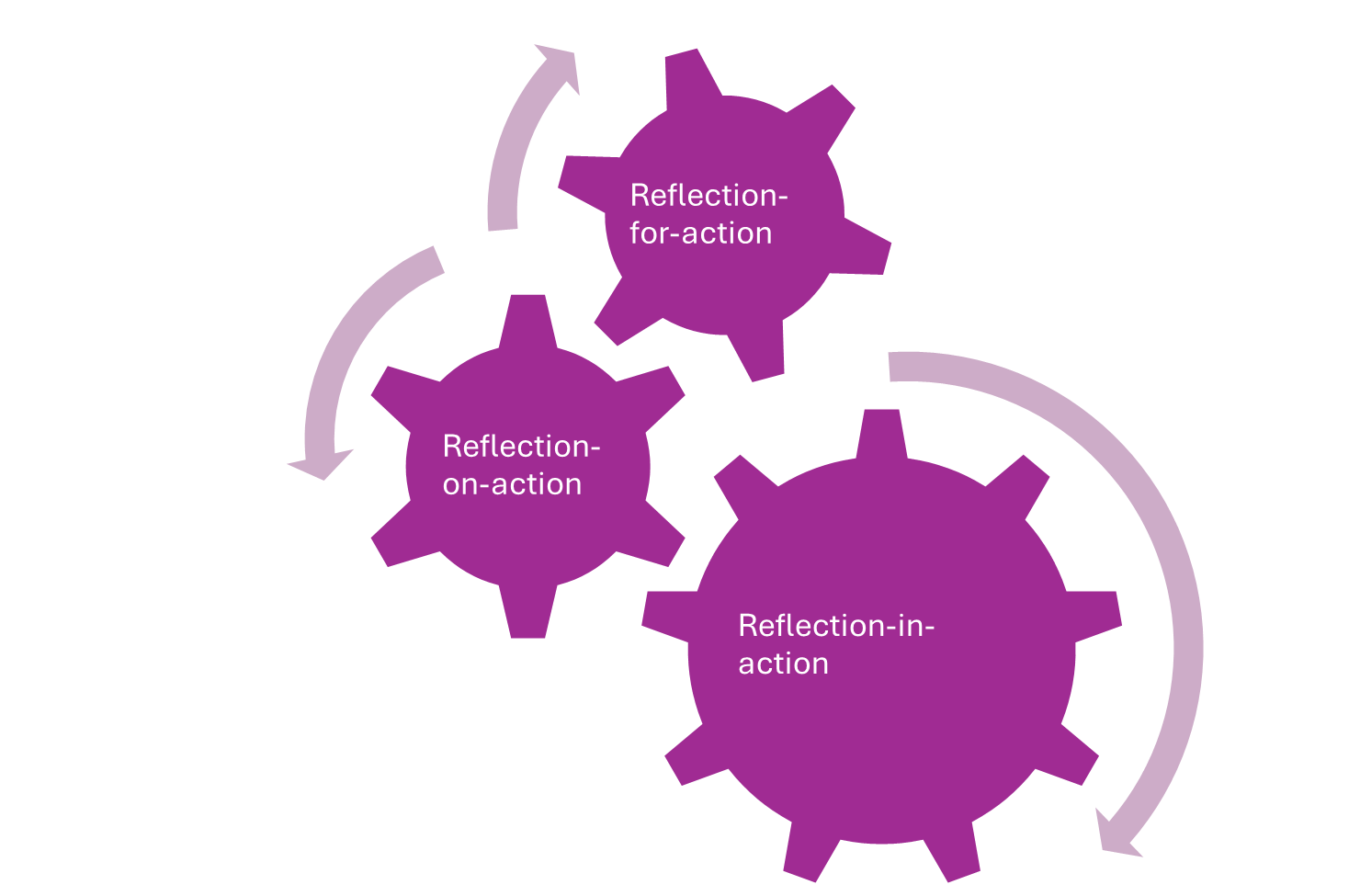
A striking finding is that not all lecturers consistently engaged in reflective practices, and there wasn’t clear evidence of a shared, structured reflective culture across the teaching team. Some lecturers could articulate a teaching philosophy, but this didn’t always translate into a repeatable reflection cycle (before, during, and after teaching). I  framed this using Dewey and Schön’s well-known reflection stages:

  • Reflection-for-action (before teaching): planning with intention
  • Reflection-in-action (during teaching): adjusting as it happens
  • Reflection-on-action (after teaching): reviewing to improve next time

Even where lecturers were clearly committed and experienced, reflection could still become fragmented, more like “minor tweaks” than a consistent, evidence-informed practice.

The real engine of reflection: lecturer-student interaction

Interaction isn’t just a teaching technique – it’s a reflection tool.

Student questions, live confusion, moments of silence, a sudden “Ohhh!” – these are data. In the study, the clearest examples of reflection happening during teaching came from lecturers who intentionally built in interaction (eg questioning strategies, pausing for problem-solving).

One example stands out: Denise’s in-class quiz is described as the only instance that embodied all three reflection components using student responses to gauge understanding, adapting support during the activity, and feeding insights forward into later planning.

Why this matters right now in UK HE

UK higher education is navigating increasing diversity in student backgrounds, expectations, and prior learning alongside sharper scrutiny of teaching quality and inclusion. In that context, reflective teaching isn’t “nice-to-have CPD”; it’s a way of ensuring our teaching practices keep pace with learners’ needs, not just disciplinary content.

The paper doesn’t argue for abandoning lectures. Instead, it shows how reflective practice can help lecturers adapt within lecture-based structures especially through purposeful interaction that shifts students from passive listening toward more active/constructive engagement (drawing on engagement ideas such as ICAP).

Three “try this tomorrow” reflective moves (small, practical, high impact)

  1. Plan one interaction checkpoint (not ten). Add a single moment where you must learn something from students (a hinge question, poll, mini-problem, or “explain it to a partner”). Use it as reflection-for-action.
  1. Name your in-the-moment adjustment. When you pivot (slow down, re-explain, swap an example), briefly acknowledge it: “I’m noticing this is sticky – let’s try a different route.” That’s reflection-in-action made visible.
  1. End with one evidence-based note to self. Not “Went fine.” Instead: “35% missed X in the quiz – next time: do Y before Z.” That’s reflection-on-action you can actually reuse.

Questions to spark conversation (for you or your teaching team)

  • Where does your teaching philosophy show up most clearly: content coverage, student confidence, relevance, or interaction?
  • Which “data” do you trust most: NSS/module evaluation, informal comments, in-class responses, attainment patterns and why?

If your programme is team-taught, what would a shared reflective framework look like in practice (so reflection isn’t isolated and inconsistent)?

If reflective teaching is the intention, this article is the nudge: make reflection visible, structured, and interaction-led, so adaptation becomes a habit, not a heroic one-off.

Dr Yetunde Kolajo is a Student Success Research Associate at the University of Kent. Her research examines pedagogical decision-making in higher education, with a focus on students’ learning experiences, critical thinking and decolonising pedagogies. Drawing on reflective teaching practice, she examines how inclusive and reflective teaching frameworks can enhance student success.


1 Comment

Want a job at Cambridge?

by GR Evans

Cambridge has arcane and complex rules and policies for jobs in the university and its colleges; despite their idiosyncracy some of them may have lessons for other institutions. GR Evans is an expert guide to the rules, the policies, national employment law and the many debates through which the Cambridge rules and policies have evolved. If you ever wondered how Cambridge works, read this.

Academic jobs with an element of security are increasingly hard to get. Fixed-term contracts have long been the norm for research-only contracts, which are usually dependent on short-term funding from a external grant. For some decades the norm for ‘academic’ posts had settled at ‘teaching and research’, with appointments to last until retirement age. However, the Equality Act of 2010, making it discriminatory to enforce retirement by age, has helped to discourage contracts promising ‘permanence’. Teaching-only posts have become more common. The Office for Students now grants degree-awarding powers to new providers of higher education but so far these have almost all been confined to powers to award ‘taught degrees’.

These trends have encouraged the use of fixed-term and casual employment of academics by many HE providers. The University and College Union has launched an Anti-Casualisation Pledge. The University of Cambridge is not one of the worst offenders in this respect, though, like other higher education providers it may make use of the device of linking the continuation of an appointment to the continuation of external, usually grant, funding. In a  case in May 2008 it was held that the University of Aberdeen had been in breach of the Fixed Term Employees (Prevention of Less Favourable Treatment) Regulations 2002 where that had been relied on, but there seems to have been no subsequent litigation helping to establish a precedent.

Under the Higher Education and Research Act (2017) institutions may set their own ‘criteria for the selection, appointment or dismissal of academic staff, or how they are applied’ (s. 2(5)(d) and s.2 (8) (b) ii.). The clause appears again later (s. 36 (1) (b)) in HERA in connection with the duty of the Office for Students to ‘protect academic freedom’ in ‘performing its access and participation functions’. 

Yet the legislation does not define ‘academic staff’ and the applicant for an academic job in Cambridge must negotiate a complex system. Titles, status, hierarchy and contracts all have their history and the University’s constitution plays a decisive part. Its governing body is made up of now more than 7,000 members of its Regent House, which must make any legislative change to its employment practice and procedure by approving a published proposal in the form of a Grace, under Statute A,III,1-2. There is some mismatch between the requirements which may be written into employment contracts and those of the Statutes and Ordinances, particularly with reference to obligations to teach. It remains the case that a new University Officer enters into Office simply by signing a book kept by the Registrary for the purpose:

Unless it is otherwise provided by Statute or Ordinance, every officer shall be admitted to their office as soon as may be after the commencement of tenure by subscribing, in a book kept at the Registry, a declaration that the officer will well and faithfully discharge all the duties of the office, and by entering in the book the date of entering upon the office. (Special Ordinance C (ii) 4)

A major reorganisation of Senior Academic Promotions and the creation of Career Pathways have left their mark. Cambridge  still offers ‘Teaching and Research’ posts but more recently it has added ‘Teaching and Scholarship’ posts with the emphasis on teaching and their own Pathway. It is seeking to create a Research Career Pathway too. The University conducts itself very transparently and both the University’s Statutes and Ordinances and its organ of historical record, the University Reporter, are online and easy to search by anyone eager to get an academic job in at Cambridge and needing to understand its advertised vacancies.

The University formerly had University Lecturers and Senior Lecturers, Readers and Professors. These titles have changed with the University’s adoption of a ‘grading’ system (Higher Education Role Analysis and Statute C, XIII). Lectureships  and Senior Lectureships have become Assistant and Associate Professorships (Grades 9 and 10), former Readerships are  Professorships (Grade 11) (by Special Ordinance, C, vii under Statute C,IX,3, Part C ) and the full Professorships are Professorships (Grade 12) (Special Ordinance, C, vii under Statute C,IX,3).  

These academic posts are ‘University Offices’ as well as employments. Such Offices may be academic-related but those successful in being appointed to a University Teaching Office (UTOs), the most desirable of its academic posts, are entitled to a sabbatical Term after each six Terms. Statute C, I, 4 requires UTOs:

 to devote themselves to the advancement of knowledge in their subject, to give instruction therein to students, to undertake from time to time such examining of students as may be required by the Board, Syndicate, or other body which is chiefly concerned with their duties, and to promote the interests of the University as a place of education, religion, learning, and research.

They must also examine for degrees and such ‘other qualifications of the University as the University may from time to time determine’. Special Ordinance C (ix) 5 requires them to give at least thirty lectures a year, or other teaching agreed as equivalent.

UTOs must belong to a Faculty or Department but they may choose to be members of more than one. This normally does not apply to those appointed to a ‘curatorial’ Office which include a teaching requirement, for example in one of the University’s museums. A recent exception allowed such an appointee in the Fitzwilliam Museum to enjoy sabbatical leave (Reporter, 31 July, 2024).

Cambridge was slow to provide its UTOs with written contracts, with many of its UTOs appointed without one and some indignation expressed about the content when they were first introduced at the beginning of this century, especially when they proved to contain intellectual property restrictions (Reporter, 31 March 2004).

University Officers are protected constitutionally by Cambridge’s Statute C which expressly guards their academic freedom and requires ‘justice and fairness’ in their treatment. A Schedule to Statute C preserves specifically for ‘academic’ staff many of the protections in the Model Statute which was framed by the Commissioners appointed as the Education Reform Act 1988 required.

The disadvantage is that academic Officers remain subject to Cambridge’s Employer-Justified Retirement Age, although as a result of the 2011 Repeal of Retirement Age Amendment to the Equality Act of 2010 other employees of the University no longer have a ‘retirement age’. Special Ordinance C (ii) 12 requires University Officers to ‘vacate their offices not later than the end of the academic year in which they attain the age of sixty-seven years’.

A Report on this requirement was published on 15 May 2024, recommending that academic-related officers should no longer be subject to the EJRA and the age of retirement should be raised to 69. The recommendations of the Report were put to a vote by ballot of the Regent House in July, with an amendment adding ‘abolition’ of the EJRA to the options. Abolition of the EJRA was rejected but the other changes were approved bringing the forced retirement age to 69 for those to whom it still applied (Reporter, 24 July, 2024). This has had the effect of shrinking still further the category of University employees subject to forced retirement.

College posts

A post in a Cambridge College may also look attractive. The University and the individual Colleges are all employers in their own right. Although in Oxford an academic is commonly employed conjointly by the University and a College, in Cambridge a University post and a College post are quite separate and some UTOs choose not to accept a College Fellowship. The choice is theirs.

Cambridge, like Oxford, has chosen not to expand its undergraduate intake because its Colleges do not have room to accommodate more, though in principle a College may choose to add to its own academic staff. The Colleges set their own rules for the employment of College Lecturers under their individual Statutes. The main task of a College Lecturer is to give supervisions to undergraduates, in the form of personal small-group teaching, though a College employee may have an ‘affiliation’ to a Department or Faculty and give occasional lectures.  There has recently been some controversy over the role of Supervisors, who may include graduate students as well as College and University lecturers, mostly concerning the rate of hourly pay available.

Colleges tend to be eager to add a University Teaching Officer to their Fellowship: a  UTO’s salary is covered by the University and the College will need to add only a small supplement. So desirable are UTOs that a UTO Scheme is published ‘to enable all Colleges to operate effectively in the educational field by ensuring a reasonable distribution of University Teaching Officers amongst them’. This explains that ‘A UTO Fellow should be regarded as a permanent educational resource for a College and not simply as a provider of undergraduate supervisions’.

Senior Academic Promotions 

The  use of the unqualified title of ‘Professor’ remains protected, and named Professorships are rarely advertised. These are ‘established’, continuing to exist when vacated, and filled by a Board of Electors appointed for the purpose. Other full Professorships are ‘personal’, granted by promotion from an existing academic University post, so to obtain one it is necessary first to gain a less senior post. Personal Professorships are created for a ‘single tenure’ and disappear when the holder resigns or retires (now superseded under Statute C,XV). The creation of such a Professorship requires the approval of  a Grace (Statute A, III,3ff).  It is possible for a ballot to be called before the approval of such a Grace, but highly unlikely.

However, during the 1990s unestablished academic posts of University Lecturer  and Senior Lecturer had begun to be created, with some unestablished posts described as ‘at the level of Professor or Reader’, though a General Board circular of 19 June 1998 limited these to five year appointments.[1] In 1996 the General Board published a Notice on ‘Titles of unestablished appointments at the level of Reader’ (Reporter, 5655, 1995-6 p512), with a further Notice in 1999 on the ‘Procedure for appointments to unestablished posts at the level of Professor or Reader’ (Reporter, 5773, 1998-9 p587).

By now controversy was afoot on the operation of the Senior Academic Promotions Procedure.  Statute D, XIV [now Special Ordinance C(vii)] stated that:

 ‘No Professorship shall be established in the University except by Grace of the Regent House after publication of a Report of the General Board’.

For those successful in gaining a personal Professorship by Promotion a Grace is published and duly approved in the normal way.

From the late 1990s there was controversy in Cambridge about ‘Senior Academic Promotions’ (Reporter, 17 November, 1999). UTOs often expressed disappointment and indignation when they failed to gain Professorships by promotion. In 1995 a General Board Notice was published establishing a procedure for making appointments to  unestablished posts ‘at Professorial level’ (Reporter, 5609, 1994-5 p381). This was felt to be needed to cover certain special cases arising where the candidate had a claim to recognition as a Research Professor through a potentially qualifying relationship with such a body as the Royal Society, Leverhulme Trust or the Medical Research Council. In each such instance the candidate was to be assessed  for a Cambridge Professorship by a committee appointed for the purpose.  

A representation was made to the Vice-Chancellor under Statute K, 5 [now Statute A,IX,1], that the General Board’s practice of making appointments to unestablished Research Professorships was in contravention of the University’s Statutes. A legal opinion was sought, which confirmed that the practice was ultra vires (Reporter, 21 March, 2001). The General Board then published the Reports with Graces necessary to create the established posts for these appointees, but on a fixed-term basis. It remains the case that a:

 competent authority may authorize the establishment of an office for a fixed term provided that there is objective justification for such authorization and shall decide what constitutes objective justification. (Statutes and Ordinances. p.673)

There were reforms, but also continuing concerns about ‘career-structures’, as a Pro-Vice-Chancellor reported in a Discussion in November 2018, suggesting that the proposed Academic Career Pathway scheme might ‘make a decisive difference in tackling some of the main areas of concern’ and ‘also serve as a platform from which to review academic titles more generally’ (Reporter, 5 June 2018). A Report proposing the introduction of Career Pathways was published in May 2019 (Reporter 15 May 2019), duly Discussed and approved, setting out the changes of title. This was Discussed on 9  June. There was acknowledgement of:

growing dissatisfaction with the existing titles and concerns about comparability with the titles adopted by the University’s peer group nationally and globally which could hinder recruitment and/or retention of academic staff and handicap our academics in competing for research funding. (Reporter, 17 June 2019)

Oxford underwent a similar review of the requirements for its own promotions to Professorships.

Career Pathways

Cambridge is now adding other ‘Pathways’ to its longstanding ‘teaching and research’ requirement for the holder of a University Teaching Office.  A Research Career Pathway is still at a planning stage but there is already a Teaching and Scholarship Pathway. On the Teaching and Research Pathway an Officer may aspire to progress from an Assistant Professorship (Grade 9), to an Associate Professorship (Grade  9 or 10), a Professorship (Grade 11) and a (personal) Professorship (Grade 12). Clinical Academic posts have their own criteria and rewards including  Clinical Professorships.

Cambridge has held back from introducing ‘Teaching-only’ offices, preferring the introduction of a Teaching and Scholarship Pathway, with the intention to ‘establish a dedicated career path for the development of staff in teaching‑focused roles’ (Reporter, 24 March, 2021). Nevertheless its introduction prompted concerns about the meaning of ‘scholarship’ in distinction from ‘Research’.  Was it to mean having read the latest books and articles rather than having written them (Reporter, 28 April 2021)? The resulting route on this Pathway involves promotions to Offices with ‘Teaching’ in their titles: Assistant and Associate Teaching Professor (Grades 9 and 10), Teaching Professor (Grade 11 and 12) and Senior Teaching Associate (Grade 8).  

Getting a job at Cambridge has its complexities, then, which may usefully be kept in mind by the would-be applicant.

SRHE member GR Evans is Emeritus Professor of Medieval Theology and Intellectual History in the University of Cambridge.


[1] I am grateful to William Astle for this reference.


3 Comments

Lessons from learning analytics

by Liz Moores and Rob Summers

Why bother collecting learning analytics data?

Some of the reported benefits of using learning analytics data include enabling personalised learning and narrowing attainment gaps. Indeed, a quick dip into some of the recent TEF feedback summaries to higher education institutions seems to suggest that use of learning analytics is valued by TEF panels. But can we learn more from the data to influence teaching practice? Aside from the potential benefits for a more personalised learning experience, we think that it’s a good way of understanding the learning process more generally. Over the past few years, we’ve been analysing some of the data generated from Aston University.

Last minute cramming is not effective in improving attainment.

Yes, your parents were correct – it’s much better to work consistently! Early engagement with studies really appears to matter. In fact, the average attainment levels of those first-year students whose engagement remained at the lowest relative levels throughout the year was very similar to those whose early engagement was lowest in the first three weeks but became the very highest in the last three weeks. In contrast, those who started off enthusiastically, but then lost interest, were awarded higher average marks than any of the groups that started off slowly, regardless of how much or whether their engagement peaked later. The consistency of the data – in that those who started off with high engagement tended to finish with high engagement – was remarkable. Also noteworthy were the effects of early engagement on attainment. For the chart below, we divided students into activity quintiles based on only their first three weeks of engagement (Q5 being the highest engagement) and on end of year mark quintiles (Q5 being the highest attainment). The width of the lines connecting engagement quintile to mark quintile is indicative of the proportion of students linking the two measures. The results highlight how few students pass from higher activity quintiles to lower mark quintiles and vice versa.

Of course, these results come with the usual caveats that we cannot infer cause and effect (it could be that the lower engagers in the first three weeks were just low achieving students). However, for us, this highlights the importance of a good induction into academic life – possibly enhanced by some structured engagement exercises to help get first years into good habits (ie tell them how they should be engaging, and the different ways that they can, not just that they should be doing so). There were probably a fair few students represented in this figure that were not even sure what they were supposed to be doing with all their ‘spare’ time

Behaviour outweighs demographics when predicting attainment

The recent pandemic generated much discussion about digital poverty, suggesting that who we teach might be important – at the very least in terms of access to technology. Our recent evidence suggests that both how you teach and who you teach mattered. However, it is important to note that behaviour outweighed demographics in predicting attainment, albeit that in this case behaviour was probably also influenced by demographics. The gap between disadvantaged students’ attainment and their peers widened during online teaching and assessment conditions, and disadvantaged students were also less likely to obtain all 120 module credits on their first try. We also observed changes in their patterns of engagement, although less so for synchronously delivered teaching (as compared to recorded lectures). Students with the lowest engagement were the ones driving the widened gap; those who engaged well with synchronously provided teaching (even if online) fared much better.

So, we should stop teaching online and get people into the classroom early?

No – not necessarily. We don’t want to claim that all online teaching is bad – instead we need to understand what forms of online teaching work, what good looks like, and how our various teaching strategies affect different groups. Anecdotally, many students have appreciated the flexibility of online teaching, particularly where it has included facilities such as the ability to ask questions anonymously. And if you want to reuse those pre-recorded videos, there has been some interesting research from other research groups on ‘watch-parties’. With the cost-of-living crisis, many students will appreciate being able to log into a lecture from home rather than forking out a bus fare or missing out on some part time work. What is important is to understand what works – and for whom.

Professor Liz Moores is Deputy Dean in the College of Health and Life Sciences at Aston University and has research interests in the evaluation of higher education, particularly as applied to widening participation issues.

Dr Rob Summers is research manager at the Centre for Transforming Access and Student Outcomes (TASO). Before joining TASO, Rob worked in the student outreach team at Aston University managing a randomised controlled trial of two post-16 outreach programmes as part of the TASO MIOM (Multi-intervention, Outreach and Mentoring) project.


Leave a comment

Landscapes of learning for unknown futures: presenter responses to audience questions (Assemblages Symposium)

by Karen Gravett and Tim Fawns

SRHE’s ‘Landscapes of Learning for Unknown Futures: prospects for space in higher education’ symposium series, delivered with Professor Sam Elkington and Dr Jill Dickinson, aims to foster continuous dialogue around learning spaces. Here, two of our presenters Dr Karen Gravett and Tim Fawns, reflect on some of the ideas and issues raised during the third symposium on ‘Assemblages’. This blog has been compiled by Sam Elkington, Jill Dickinson, and Rihana Suliman (SRHE Conferences and Events Manager.)

What is the role for human agency in these types of assemblages with human and non-human actors, so as not to feel helpless or a “cog” while respecting the need to de-centre the human?

Karen: Humans still have a key role within assemblages but the perspective is shifted from thinking about the relational connection between humans and nonhumans or materials. This enables us to ask new questions, for example with respect to teaching in a classroom, we might notice not just what the teacher is doing or student is doing, but how the space and objects within the class interrelate and entangle to shape learning in different ways. How do bodies and spaces work together and connect? How are relations shaped by object-space arrangements in classrooms and what inclusions or exclusions are produced as a result?

Tim: Agency is always relational, contingent on the agency of other elements. The agency of humans is constrained by the people, technologies and materials we are bound to or surrounded by. However, a complex understanding of constraint also allows for more agency, because by understanding how they are constrained, humans have more possibilities for action. We can more clearly where we can act on entangled relations. For example, by better understanding our place within a system, we can more easily see the different places where we might be able to reconfigure things to free up space to move.

The teaching approach at many HE institutions is heavily lecture-based. How does this lack of interaction with students affect the conversation we’re having around assemblages and learning space more broadly?

Karen: Teaching that does not include interactions between students and teachers or students and peers and that is transmission focused suits many of the traditional tiered teaching spaces that still dominate UK universities today. This is how we often assume teaching should ‘be done’ to students. If we think about these kinds of object-space arrangements we can see that they may not be conducive to creating meaningful dialogue, to fostering relationships, to engaging a diversity of learners, or to enabling innovative teaching to happen. Fortunately, there is also a lot of creative teaching that is happening both within and beyond these spaces that teachers can learn from. Teachers have always found ways to be subversive and also institutions are increasingly creating new and more flexible learning spaces.

Tim: I am wary of assumptions that there is no interaction in lectures. There is always interaction (and intra-action) in any educational activity; that is one of the premises of an assemblage. In this question, the lack of interaction is seen from the teacher’s point of view. It is important that we focus on what students are actually doing rather than what we assume they must be doing according to a particular teaching method. Spaces are always complex; there are always many things going on, many of which will divert from our expectations. However, the material configuration of a space (e.g. tiered lecture seating and a podium), and the scheduling of time, do impose real constraints on the activity that is likely to manifest. Within any method, we can tinker with these parameters of material and temporal configuration and, thereby, open up more possibilities for agency.

Where does collaborative learning happen in our future learning landscapes? We still seem to work in a very individualist learning mode, through assessment practices to curricula and beyond…

Karen: Yes there is a real need to move beyond values of individualism that are present within both academia and society, and to think about our relational connections and how these matter. Collaboration can happen everywhere and anywhere – via a student-staff partnership project; via dialogic modes of teaching, via group work, via walking and other creative pedagogies. Online and offline. We just have to value it and make it happen.

Tim: That our assessment processes and practices, and our formal structures of higher education, are so tightly configured around individualist learning is a challenge. However, it doesn’t change the fact that collaborative learning is inevitable and, to me, the primary form of learning, particularly if we are thinking of assemblages. As we continue to embed more collective and collaborative practices in education, such as student co-design, group work, and the integration of artificial intelligence technologies, alternative narratives will emerge that fit better with our experiences of collective learning and education. It will be fascinating to see if we adapt practices, policies and structures in response, and how the different narratives – collective and individual – will co-exist in tension and negotiation.

Some universities have created a lot of flexible collaborative classroom spaces – we find that when we create them at my institution, faculty either don’t know how to utilise them or prefer to still use them as lecture halls continuing the individualist learning.  How can we create a space that ‘entangles’ both?

Karen: I find really helpful what Diane Mulcahy (2018, p 13) says about space, that “Thinking the term ‘learning spaces’ as something we do (stage, perform, enact), rather than something we have (infrastructure) affords acknowledging the multiplicity, mutability and mutual inclusivity of spatial and pedagogic practices”. In this case educators may need support to think about how they can make and enact the classroom to become an inclusive space. In my institution this happens via conversations for example as part of our PGCLTHE or other peer observation and mentoring practices. Perhaps teachers could be supported to see different ways to teach and to learn from others who are innovating and experimenting in the classroom.

Tim: The configuration of those spaces is actually a big step forward, even if practice and culture are slow to adapt to the new possibilities. A large part of what we need to do now is share practice and engage in open conversations about new possibilities. Individualist teaching may be the bigger barrier here: if we teach as individuals not as teams, and if we don’t talk enough about what we are all doing, we will have less exposure to alternative ways of educating. I think we are then less likely to develop practices that attune to wider contexts and possibilities.

Reference

Mulcahy, Dianne (2018) ‘Assembling Spaces of Learning ‘In’ Museums and Schools: A Practice-Based Sociomaterial Perspective.’ in Spaces of Teaching and Learning, Understanding Teaching-Learning Practice, edited by Ellis, E and Goodyear, P 13–29. Singapore: Springer

Dr Karen Gravett is Associate Professor and Director of Research at the Surrey Institute of Education at the University of Surrey, UK, where her research focuses on the theory-practice of higher education, and explores the areas of student engagement, belonging, and relational pedagogies. She is Director of the Language, Literacies and Learning research group, a member of the SRHE Governing Council, and a member of the editorial board for Teaching in Higher Education, and Learning, Media and Technology. Her work has been funded by the Economic and Social Research Council, the Society for Research in Higher Education, the Association for Learning Development in Higher Education, the British Association for Applied Linguistics, and the Arts and Humanities Research Council. Her latest books are: Gravett, K. (2023) Relational Pedagogies: Connections and Mattering in Higher Education, and Kinchin, IM and Gravett, K (2022) Dominant Discourses in Higher Education.

Tim Fawns is Associate Professor at the Monash Education Academy, Monash University, Australia. Tim’s research interests are at the intersection between digital, clinical and higher education, with a particular focus on the relationship between technology and educational practice. He has recently published a book titled Online Postgraduate Education in a Postdigital World: Beyond Technology. Personal website: http://timfawns.com. Twitter: @timbocop

Paul Ashwin


Leave a comment

Going global – opportunities and challenges for HE researchers

By Paul Ashwin

Globally participation in Higher Education is rising rapidly. UNESCO figures for enrolment in tertiary education show that globally, participation rose from 19% in 2000 to 32% in 2012. It is also increasingly an international phenomenon; for example, the number of students studying abroad more than doubled from 2.1m in 2000 to 4.5m in 2012.

The increasing numbers of students internationally has contributed to greater scrutiny of higher education, as it has become a key focus of national and international policy makers. This scrutiny has led to unparalleled information about HE. This greater information presents higher education researchers with both challenges and possibilities because it both tells us more about higher education whilst also simplifying its complexities.

If we take the quality of higher as an example, the recent Yerevan Communiqué from EU Higher Education Ministers declared that “Enhancing the quality and relevance of teaching and learning is the main mission of the EHEA”. This both elevates the status of teaching and learning whilst also raising pressing questions about how we judge the quality of teaching in higher education.

Positions in national and international higher education league tables have become a dominant way of representing this quality. Their attraction is understandable: Continue reading