SRHE Blog

The Society for Research into Higher Education


Leave a comment

The missing middle ground between research-led and practice-led education

by Saeed Talebi and Nick Morton

A peer reviewer recently challenged our pedagogical approach. We had described embedding an industry-led research project on Digital Twin development into our built environment curriculum as ‘research-informed teaching’. The reviewer disagreed: this was ‘practice-led rather than research-informed,’ they argued, because students weren’t producing research outputs themselves.

The comment revealed a conceptual confusion we suspect is widespread in higher education. We often assume that if students aren’t producing original research, then any industry-focused teaching must simply be vocational training with academic window-dressing. This leaves practice-facing disciplines in an awkward position: industry engagement is essential to what we do, but it risks being dismissed as less scholarly. There is, however, a middle ground.

Healey and Jenkins’ (2009) model offers a useful way through this confusion. They identify four modes of engaging undergraduates with research: research-led (learning about current scholarship), research-oriented (learning research methods), research-based (undertaking inquiry), and research-tutored (engaging in research discussions). These are mapped across two dimensions: whether students are positioned as audience or participants, and whether the emphasis falls on research content or processes. The model’s key insight is that students can be meaningfully engaged with research even when they aren’t producing research outputs themselves. The question isn’t simply whether students are ‘doing research’, it’s whether they’re positioned as passive recipients of established knowledge or as active participants in scholarly inquiry.

Practice-led teaching operates on different logic, though that logic has a closer relationship to applied research than is sometimes acknowledged. Its primary aim is developing professional competence through authentic engagement with messy problems and competing stakeholder priorities. The distinction isn’t whether industry is involved – it can be present in both approaches. The distinction lies in how students are positioned in relation to knowledge. In practice-led education, knowledge tends to be treated as relatively settled. In research-informed education, knowledge is contested, evolving, and open to question. An opportunity arises when these approaches coincide without conscious design, and a risk emerges when they collapse into one another. Research-informed teaching can become performative, referencing staff publications without changing how students learn. Practice-led teaching can slip into employability theatre, where live briefs are added without interrogating what knowledge students are actually developing.

As Professor Hanifa Shah OBE recently argued in Times Higher Education, STEAM education at its best equips students to “move fluidly between analytical and imaginative modes of thinking“, asking critical questions, considering ethical implications, and bringing meaning to innovation. This is precisely the disposition that research-informed teaching seeks to develop. In STEAM disciplines, including architecture, built environment, computing and engineering, emerging technologies create spaces where research and practice intersect meaningfully. Digital Twins and real-time monitoring tools, for example, allow students to work with live systems while engaging critically with the assumptions and ethics embedded within them. Students aren’t merely applying research after the fact, nor mimicking professional routines. They’re learning to question how data is generated, how models simplify reality, and how decisions are shaped by both evidence and judgement. Practice becomes a site of inquiry.

There’s an institutional dimension here too. Across the sector, promotion frameworks, workload models, and teaching quality metrics often reward research visibility and industry engagement without asking how either is translated pedagogically. Academics are encouraged to ‘bring research into teaching’ and ‘embed employability’, yet rarely supported in doing the difficult design work that meaningful integration requires. Recent discussions within the sector have highlighted how delivery models shape the possibilities for integrating academic and workplace learning. These are sector-wide conversations, and they reflect shared challenges around diverse learner cohorts, blended delivery, and the risk of compliance overtaking genuine learning. As a result, many innovative practices remain dependent on individual effort rather than structural support.

None of this means practice-led and research-informed approaches are mutually exclusive. The most effective curricula often blend elements of both. But blending deliberately is quite different from conflating accidentally.

When designing industry-engaged teaching, it’s worth asking honest questions. Are students positioned as inquirers or executors? Are they engaging with contested knowledge or settled practice? Does assessment reward critical reflection or merely competent performance? Is the industry project a vehicle for scholarly inquiry, or is scholarly framing a veneer over vocational training?

The answers won’t always be clear-cut, and that’s fine. But asking the questions helps us design with intention rather than stumbling into confusion – and helps us articulate what we’re doing when a peer reviewer, a sceptical colleague, or a university committee asks us to justify our approach.

Dr Saeed Talebi is an Associate Professor in the Department of Architecture and Built Environment at Birmingham City University and a Senior Fellow of the Higher Education Academy (SFHEA). He has held a number of T&L leadership roles, including Departmental Lead, Course Leader, and Academic Lead for Teaching Excellence and Student Experience. He has a keen interest in pedagogy in higher education, with particular interest in research-informed teaching and the integration of emerging technologies and practice-led projects into built environment curricula to enhance student outcomes and experience. He has also led the delivery of large STEAM research projects.

Professor Nick Morton is the Academic Director of Partnerships and STEAM at Birmingham City University. A Principal Fellow of the Higher Education Academy (PFHEA), he was awarded a National Teaching Fellowship in recognition of his track record in curriculum development. He has held a number of senior leadership roles at BCU, including Associate Dean for Teaching Education and Student Experience, overseeing Computing, Engineering and the Built Environment. He was elected Vice-Chair of the Council of Heads of the Built Environment (CHOBE) in 2012 and is a Fellow of the Royal Institution of Chartered Surveyors (FRICS).

2 Comments

Reflective teaching: the “small shifts” that quietly change everything

by Yetunde Kolajo

If you’ve ever left a lecture thinking “That didn’t land the way I hoped” (or “That went surprisingly well – why?”), you’ve already stepped into reflective teaching. The question is whether reflection remains a private afterthought … or becomes a deliberate practice that improves teaching in real time and shapes what we do next.

In Advancing pedagogical excellence through reflective teaching practice and adaptation I explored reflective teaching practice (RTP) in a first-year chemistry context at a New Zealand university, asking a deceptively simple question: How do lecturers’ teaching philosophies shape what they actually do to reflect and adapt their teaching?

What the study did

I interviewed eight chemistry lecturers using semi-structured interviews, then used thematic analysis to examine two connected strands: (1) teaching concepts/philosophy and (2) lecturer-student interaction. The paper distinguishes between:

  • Reflective Teaching (RT): the broader ongoing process of critically examining your teaching.
  • Reflective Teaching Practice (RTP): the day-to-day strategies (journals, feedback loops, peer dialogue, etc) that make reflection actionable.

Reflection is uneven and often unsystematic

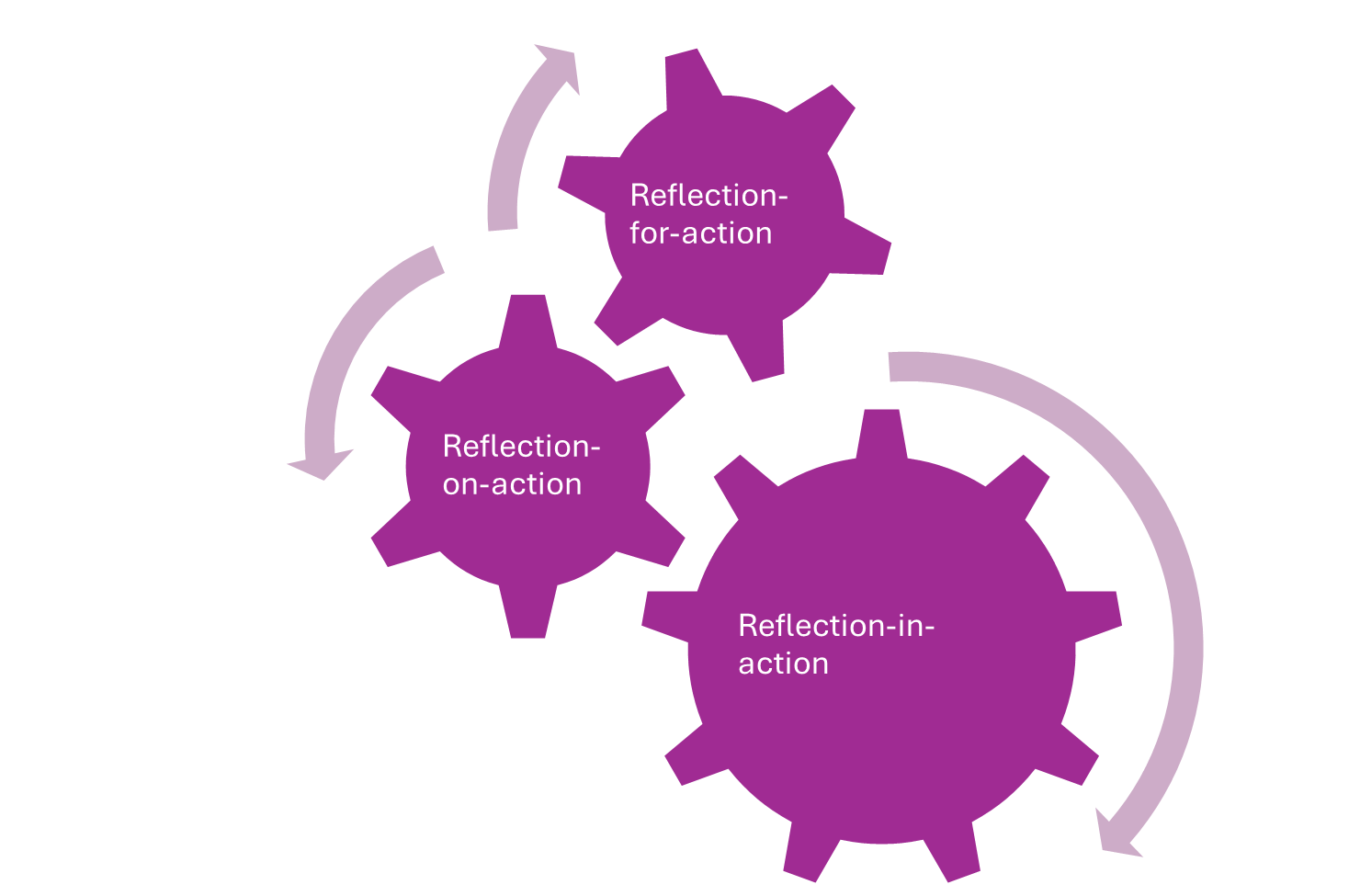
A striking finding is that not all lecturers consistently engaged in reflective practices, and there wasn’t clear evidence of a shared, structured reflective culture across the teaching team. Some lecturers could articulate a teaching philosophy, but this didn’t always translate into a repeatable reflection cycle (before, during, and after teaching). I  framed this using Dewey and Schön’s well-known reflection stages:

  • Reflection-for-action (before teaching): planning with intention
  • Reflection-in-action (during teaching): adjusting as it happens
  • Reflection-on-action (after teaching): reviewing to improve next time

Even where lecturers were clearly committed and experienced, reflection could still become fragmented, more like “minor tweaks” than a consistent, evidence-informed practice.

The real engine of reflection: lecturer-student interaction

Interaction isn’t just a teaching technique – it’s a reflection tool.

Student questions, live confusion, moments of silence, a sudden “Ohhh!” – these are data. In the study, the clearest examples of reflection happening during teaching came from lecturers who intentionally built in interaction (eg questioning strategies, pausing for problem-solving).

One example stands out: Denise’s in-class quiz is described as the only instance that embodied all three reflection components using student responses to gauge understanding, adapting support during the activity, and feeding insights forward into later planning.

Why this matters right now in UK HE

UK higher education is navigating increasing diversity in student backgrounds, expectations, and prior learning alongside sharper scrutiny of teaching quality and inclusion. In that context, reflective teaching isn’t “nice-to-have CPD”; it’s a way of ensuring our teaching practices keep pace with learners’ needs, not just disciplinary content.

The paper doesn’t argue for abandoning lectures. Instead, it shows how reflective practice can help lecturers adapt within lecture-based structures especially through purposeful interaction that shifts students from passive listening toward more active/constructive engagement (drawing on engagement ideas such as ICAP).

Three “try this tomorrow” reflective moves (small, practical, high impact)

  1. Plan one interaction checkpoint (not ten). Add a single moment where you must learn something from students (a hinge question, poll, mini-problem, or “explain it to a partner”). Use it as reflection-for-action.
  1. Name your in-the-moment adjustment. When you pivot (slow down, re-explain, swap an example), briefly acknowledge it: “I’m noticing this is sticky – let’s try a different route.” That’s reflection-in-action made visible.
  1. End with one evidence-based note to self. Not “Went fine.” Instead: “35% missed X in the quiz – next time: do Y before Z.” That’s reflection-on-action you can actually reuse.

Questions to spark conversation (for you or your teaching team)

  • Where does your teaching philosophy show up most clearly: content coverage, student confidence, relevance, or interaction?
  • Which “data” do you trust most: NSS/module evaluation, informal comments, in-class responses, attainment patterns and why?

If your programme is team-taught, what would a shared reflective framework look like in practice (so reflection isn’t isolated and inconsistent)?

If reflective teaching is the intention, this article is the nudge: make reflection visible, structured, and interaction-led, so adaptation becomes a habit, not a heroic one-off.

Dr Yetunde Kolajo is a Student Success Research Associate at the University of Kent. Her research examines pedagogical decision-making in higher education, with a focus on students’ learning experiences, critical thinking and decolonising pedagogies. Drawing on reflective teaching practice, she examines how inclusive and reflective teaching frameworks can enhance student success.


Leave a comment

To ‘think like a lawyer’: some thoughts on the pedagogy of international law

by Paolo Amorosa & Sebastián Machado

Most law professors face a similar challenge when designing their courses: how to explain to students the enduring gap between what the law says and how it functions in reality. One of the foundational assumptions of legal education is that law is more than just the written rules found in statutes, bills, or constitutions. Without an understanding of how these rules influence a judge’s decision-making, they remain little more than pretty playthings: abstract ideas with no real-world impact. This realist approach in domestic legal education helps bridge the divide between legal theory and practice; the same arguments might apply in most disciplines and fields with a similar divide between theory and practice. If you can examine a rule and confidently predict how it will be applied, you are engaging in the most basic form of legal research. But consider a legal system without a centralised rule-making authority or a single, binding interpreter – no supreme legislature or final court to settle disputes definitively. This is the reality of international law. While there are many judicial and quasi-judicial bodies, there is no universal, mandatory forum for resolving disputes, and most conflicts never reach a formal judgment. Instead, states, international organizations, and individuals all contribute to shaping the rules by advocating for their preferred interpretations, hoping to sway the broader consensus. International lawyers refer to this evolving consensus as the ‘invisible college of international lawyers’, a term that captures the discipline’s informal, socially constructed boundaries. In essence, international law is what international lawyers do.

Teaching international law, then, comes with an added layer of complexity: the lack of formal structures undermines legal certainty. Every international lawyer, to some degree, can influence the field. Through journal articles, blog posts, social media debates, or legal practice, they argue for their version of the correct interpretation of a rule. Academics may even challenge established meanings, making persuasive cases that defy the literal text of foundational documents like the UN Charter.

This is why international lawyers often say that the law is made, not found. Unlike domestic legal systems, where rules are either codified (as in civil law) or derived from judicial precedent (as in common law), international law is fundamentally discursive. This creates a twofold problem. First, without an authoritative interpreter, there is no clear way to separate theory from practice. A legal advisor in a Foreign Ministry might frame a state’s actions as part of a new trend that modifies a rule (such as pre-emptive self-defense), while others denounce it as a violation (like Article 51 of the UN Charter). In this environment, the line between legal theory and practice dissolves. Second, with no objective boundaries to the discipline, the distinction between mainstream international law and critical approaches collapses. What remains is the professor’s choice: which version of the law to teach.

Yet teaching international law does not require taking a stance on the theory-practice divide, because that divide is not inherent to the discipline. Law professors are not bound by the same rigid distinctions as, say, natural scientists, who must separate theoretical models from empirical observation. Instead, legal education can bypass this dichotomy entirely by focusing on the deeper conditions that shape how we understand both theory and practice. Rather than treating practice as a constraint on theory, students can learn to apply theoretical insights pragmatically. This approach allows law schools to teach practical skills without forcing an artificial separation between legal thought and legal action, following larger trends in pedagogical training outside legal academia.

Still, many international law professors struggle with curriculum design because of these perceived divides. On one hand, students must master a baseline of doctrinal knowledge to enter legal practice. On the other, mere knowledge acquisition is not enough – students must also develop the ability to analyse, synthesise, and critically evaluate legal arguments. A well-rounded legal education should cultivate these higher-order skills, enabling students to engage in meta-cognitive reflection about the law they are learning.

Moreover, there is no strong evidence that ‘thinking like a lawyer’ is a unique cognitive skill. Legal reasoning shares much with other forms of reasoning, meaning that better teaching methods alone will not necessarily produce better lawyers. Instead, what matters is equipping students with evaluative tools to interpret and refine legal arguments. By treating core legal knowledge as a foundation rather than a rigid boundary, and critical thinking as a method for engaging with that knowledge, the supposed divide between mainstream and critical approaches begins to fade.

The same logic applies to the theory-practice debate. The tension between these approaches persists only if we assume they are mutually exclusive. Law schools often face criticism from practitioners who argue that graduates lack practical skills, while academics defend the importance of theoretical training. But must these roles be in conflict?

Perhaps the real issue in international law is not the existence of these divides, but our insistence on treating them as inevitable. If there is little evidence that ‘thinking like a lawyer’ is a distinct cognitive skill, there is even less reason to impose it as a rigid framework for international legal education. Instead, we might focus on cultivating adaptable, reflective practitioners who can navigate both theory and practice – not as opposing forces, but as complementary dimensions of the same discipline. This is a lesson relevant for many if not all professional disciplines.

Sebastian Machado Ramírez is Postdoctoral Researcher at the University of Helsinki, where he works on the PRIVIGO project examining private governance and international law. He holds a PhD from the University of Melbourne, where his dissertation analyzed interpretive approaches in the law governing the use of force.

Paolo Amorosa is University Lecturer in International Law at the University of Helsinki. He holds a PhD from the same institution and specializes in the history and theory of international law and human rights. His monograph Rewriting the History of the Law of Nations (OUP 2019) critically re-examines the ideological foundations of international law’s canon.