SRHE Blog

The Society for Research into Higher Education


2 Comments

Reflective teaching: the “small shifts” that quietly change everything

by Yetunde Kolajo

If you’ve ever left a lecture thinking “That didn’t land the way I hoped” (or “That went surprisingly well – why?”), you’ve already stepped into reflective teaching. The question is whether reflection remains a private afterthought … or becomes a deliberate practice that improves teaching in real time and shapes what we do next.

In Advancing pedagogical excellence through reflective teaching practice and adaptation I explored reflective teaching practice (RTP) in a first-year chemistry context at a New Zealand university, asking a deceptively simple question: How do lecturers’ teaching philosophies shape what they actually do to reflect and adapt their teaching?
What the study did

I interviewed eight chemistry lecturers using semi-structured interviews, then used thematic analysis to examine two connected strands: (1) teaching concepts/philosophy and (2) lecturer-student interaction. The paper distinguishes between:

  • Reflective Teaching (RT): the broader ongoing process of critically examining your teaching.
  • Reflective Teaching Practice (RTP): the day-to-day strategies (journals, feedback loops, peer dialogue, etc) that make reflection actionable.

Reflection is uneven and often unsystematic

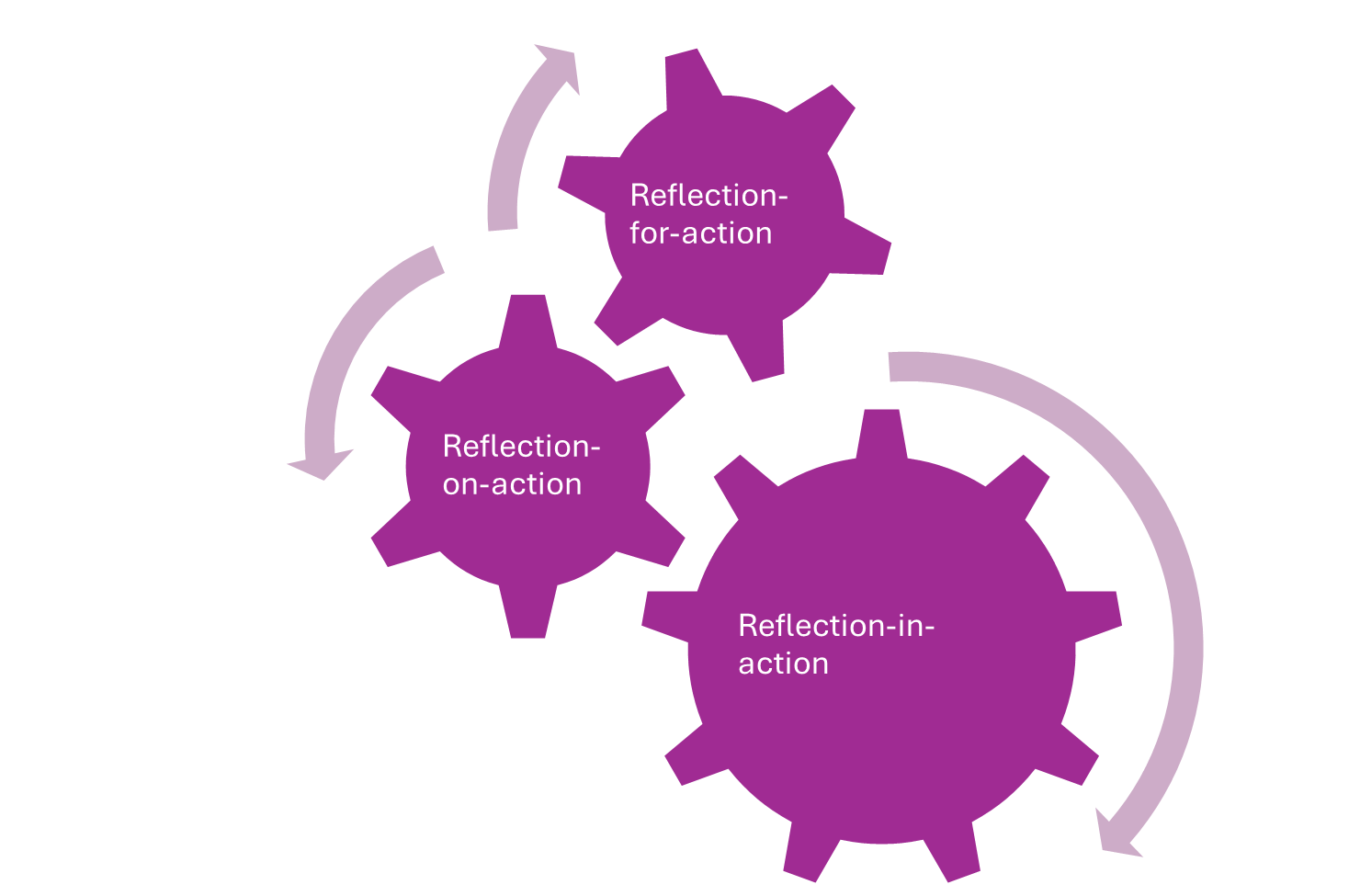
A striking finding is that not all lecturers consistently engaged in reflective practices, and there wasn’t clear evidence of a shared, structured reflective culture across the teaching team. Some lecturers could articulate a teaching philosophy, but this didn’t always translate into a repeatable reflection cycle (before, during, and after teaching). I  framed this using Dewey and Schön’s well-known reflection stages:

  • Reflection-for-action (before teaching): planning with intention
  • Reflection-in-action (during teaching): adjusting as it happens
  • Reflection-on-action (after teaching): reviewing to improve next time

Even where lecturers were clearly committed and experienced, reflection could still become fragmented, more like “minor tweaks” than a consistent, evidence-informed practice.

The real engine of reflection: lecturer-student interaction

Interaction isn’t just a teaching technique – it’s a reflection tool.

Student questions, live confusion, moments of silence, a sudden “Ohhh!” – these are data. In the study, the clearest examples of reflection happening during teaching came from lecturers who intentionally built in interaction (eg questioning strategies, pausing for problem-solving).

One example stands out: Denise’s in-class quiz is described as the only instance that embodied all three reflection components using student responses to gauge understanding, adapting support during the activity, and feeding insights forward into later planning.

Why this matters right now in UK HE

UK higher education is navigating increasing diversity in student backgrounds, expectations, and prior learning alongside sharper scrutiny of teaching quality and inclusion. In that context, reflective teaching isn’t “nice-to-have CPD”; it’s a way of ensuring our teaching practices keep pace with learners’ needs, not just disciplinary content.

The paper doesn’t argue for abandoning lectures. Instead, it shows how reflective practice can help lecturers adapt within lecture-based structures especially through purposeful interaction that shifts students from passive listening toward more active/constructive engagement (drawing on engagement ideas such as ICAP).

Three “try this tomorrow” reflective moves (small, practical, high impact)

  1. Plan one interaction checkpoint (not ten). Add a single moment where you must learn something from students (a hinge question, poll, mini-problem, or “explain it to a partner”). Use it as reflection-for-action.
  1. Name your in-the-moment adjustment. When you pivot (slow down, re-explain, swap an example), briefly acknowledge it: “I’m noticing this is sticky – let’s try a different route.” That’s reflection-in-action made visible.
  1. End with one evidence-based note to self. Not “Went fine.” Instead: “35% missed X in the quiz – next time: do Y before Z.” That’s reflection-on-action you can actually reuse.

Questions to spark conversation (for you or your teaching team)

  • Where does your teaching philosophy show up most clearly: content coverage, student confidence, relevance, or interaction?
  • Which “data” do you trust most: NSS/module evaluation, informal comments, in-class responses, attainment patterns and why?

If your programme is team-taught, what would a shared reflective framework look like in practice (so reflection isn’t isolated and inconsistent)?

If reflective teaching is the intention, this article is the nudge: make reflection visible, structured, and interaction-led, so adaptation becomes a habit, not a heroic one-off.

Dr Yetunde Kolajo is a Student Success Research Associate at the University of Kent. Her research examines pedagogical decision-making in higher education, with a focus on students’ learning experiences, critical thinking and decolonising pedagogies. Drawing on reflective teaching practice, she examines how inclusive and reflective teaching frameworks can enhance student success.


2 Comments

Offering a curriculum change evaluation tool

by Camille Kandiko Howson and Martyn Kingsbury

This blog offers an overview of a curriculum evaluation tool, part of a recently published article ‘Curriculum change as transformational learning’, in Teaching in Higher Education.

A decade ago, one of us led a strand of work exploring global best practice in whole-institution curriculum change, as part of a wider Higher Education Funding Council for England (HEFCE) project. The resulting book, Strategic Curriculum Change, identified that while huge amounts of time and money were spent doing large-scale curriculum change, as well as vast costs on the subsequent marketing of it, next to nothing was invested in evaluating it.

One of the main challenges is that while a curriculum change initiative starts off as a separate project, it eventually becomes business as usual. Such change efforts often come at a high political cost as well, with senior leaders often moving on and leaving the implementation to others. Many efforts never really get off the ground, instead lingering and taking on board new ideas, blending the old and the new. These may water down the original vision and drive for change, further hindering evaluation.

Evaluating change

We have recently had the opportunity to remedy this gap, through evaluating a whole-institution curriculum review project, part of a comprehensive nine-year investment plan to reposition teaching and learning within an institution. While it is easy to check the administrative side of a change effort (were boxes ticked, forms filled out), analysing the whether the ethos, purpose and guiding principles were adopted requires a much more nuanced approach.

We designed a multi-stage evaluation plan to explore to what extent were the principles of a Learning and Teaching Strategy embedded within new curriculum structures, as well as the impact on personal and disciplinary culture.

This output provides insight into the first stage of curriculum change – taking new ideas and pedagogical approaches and building them into the bricks and mortar of the educational experience and into the minds and practices of those delivering the curriculum. This approach allows for evaluating to what extent a change effort is just words on a slick new webpage, or whether there has been a transformation of the curriculum.

The review in context

The review is based in a highly devolved, mid-size urban research-intensive institution in the UK. The institutional change programme is based on four pillars:

1) Assessment Reform: A review of curricula with the objective of reducing over-assessment

2) Active Learning: An evidence-based transformation of pedagogy, to make teaching more discovery-based

3) Diversity and Inclusion: The fostering of an inclusive and diverse culture and sense of belonging

4) Digital and Technology Enhanced Learning: The development of online and digital tools to enhance curricula, pedagogy and community

We evaluated the degree of departmental engagement with the institution-wide curriculum review policy through a discourse analysis of three sources: 1) a public Learning and Teaching Strategy; 2) internal Curriculum Redesign Forms, the quality assurance process stating changes, rationale and engagement; and 3) external Programme Specifications, detailing the educational offer for prospective students.

The evaluation tool

We designed an evaluation rubric, and in the paper we cover two aspects of it. The first explores engagement with the four pillars of the Strategy in the Curriculum Redesign Forms, through the adoption of language, intent and application, resulting in 12 indicators. This allowed us to evaluate the degree to which words and meaning of the Strategy were embedded within the new curriculum structures of the departments.

We also explored the alignment of the Curriculum Redesign Forms and the Programme Specification, focusing on the sections on Programme Overview, the Learning Outcomes, the Learning and Teaching Approach and the Assessment Strategy. This led to another 16 indicators. This offered insight into the extent the internal changes had made it into the public ‘offering’ of the course.

These 28 indicators were judged on a scale of Absent, Vague, Implicit, Present, Explicit. Scores were assigned and each department in the institution was reviewed by the researchers. We found varying engagement across the pillars of the Strategy and the challenge of applying principles in practice. We identified three different patterns of engagement across departments, with ‘active’ departments integrating the aims of the Strategy with disciplinary knowledge and pedagogy, ‘engaged’ departments adopting much of intent of the strategy, and group of ‘passive’ departments with minimal engagement and a focus on structural changes.

We hope this research and evaluation tool help others conduct evaluation of curriculum change. We found this approach uncovered both structural and cultural change. This is just the start of our research on curriculum change, and we hope it kickstarts other curriculum change research and evaluation, whether at the institution, faculty or departmental level.

SRHE member Dr Camille Kandiko Howson is Associate Professor of Education in the Centre for Higher Education Research and Scholarship at Imperial College London. Follow Camille on Twitter @cbkandiko

SRHE member Professor Martyn Kingsbury is Director of the Centre for Higher Education Research and Scholarship at Imperial College London.

Ian Kinchin


Leave a comment

Student evaluation of teaching: are we reaching for the wrong type of excellence?

By Ian Kinchin

Over twenty years ago Carr (1994: 49) wrote:

 ‘It is a shallow and false view of education and teaching which takes it to be a matter of the technical transmission of pre-packaged knowledge and skills in the context of efficient management’

However, it seems that this false view is still able obscure a more contemporary and research-informed views of teaching. The on-going drive for ‘teaching excellence’ still seems to focus on actions of the teacher that promote Carr’s ‘shallow view’. That is not to say that the student voice is not important, but we need to ensure that students are asked the right questions so that we do not promote student passivity as learners and do not subvert the student voice for purely political ends.

Fitzgerald et al (2002) wrote Continue reading