SRHE Blog

The Society for Research into Higher Education


Leave a comment

In defence of SoTL: anchoring educational evaluation and educational research

by Liz Austen

By the end of 2025 I had attended three HE related conferences: Euro SoTL, the Wonkhe Festival of HE and the SRHE Annual Conference. I presented on similar topics at all three events; what evidence do we generate to help us understand and act to enhance student experiences and outcomes in higher education? During the Wonkhe panel and my SRHE session, I defined two approaches at the disposal of HE practitioners:

Higher Education Evaluation: an approach which helps to understand and explore what works and doesn’t work in a given context and is of value to stakeholders. The aim of evaluation is to generate actionable evidence-informed learning, which encourages, informs and supports continuous improvement of process and impact (Evaluation Collective 2025)

Higher Education Research: to extend knowledge and understanding in all areas of educational activity and from a wide range of perspectives, including those of learners, educators, policymakers and the public (adapted from BERA, 2024)

At the Wonkhe panel, Clare Loughlin-Chow (CEO of SRHE) helpfully outlined the higher education research topics that were most prevalent in the SRHE journals. Omar Khan (CEO of TASO) then outlined the scope and priories of TASO, an affiliate member of the government’s What Works Network which focuses on higher education evaluation. My conceptual discussion of evidence generation brought the two together.

At EuroSoTL earlier in the year, my colleagues and I outlined our new institutional approach to the Scholarship of Teaching and Learning:

Scholarship of Teaching and Learning (SoTL): to improve student learning through engagement in the existing knowledge of teaching and learning, developing contextual ideas and innovation in practice, reflecting on practice, applying methodological rigour, working in partnership with students, and sharing of scholarship publicly (adapted from Felton (2013))

When I attended SRHE in December 2025, SoTL appeared in only one session I attended and some of this discussion focused on the challenges of bringing SoTL into spaces for educational research. My hand in the air comment – that criticism of SoTL by educational researchers was an example of ‘academic snobbery’ – certainly raised a few eyebrows. This blog post considers the relationship between these three approaches and whether, for the good of our students, it’s time for some reconciliation.

Educational evaluation, SoTL and educational research

Educational research in higher education has developed over the last 60 years. Interestingly, research into teaching and learning is cited as the most theorised by this type of research (Tight, 2012). Higher education evaluation, sometimes considered as applied research, was recently propelled by the Office for Students’ agenda to ‘evaluate, evaluate, evaluate (Office for Students, 2022). SoTL has developed alongside HE research and evaluation, emerging from Boyer’s work in 1990.

The aims of each endeavour are distinct, tied by the notion of ‘enquiry’. Research seeks to build new knowledge, and evaluation seeks to provide judgment on a contextual problem. SoTL has a narrower focus on teaching and learning than the broader scope of research and evaluation but incorporates prior knowledge and contextual problem solving through focused enquiry (Gray, 2025). SoTL builds on the foundation of social sciences methodology and can integrate disciplinary methodology into practitioner’s teaching and learning enquiry (Riddell, 2026). Educational evaluation often asks questions of the effectiveness of interventions, but in some teaching and learning spaces, the evaluative language of ‘intervention’ isn’t appropriate (Austen (2025) in Austen and McCaig (2025)). Exploring what works through SoTL enquiry aligns better. Often the bridging term ‘pedagogic research’ is used as integral to SoTL (close to practice) but distinct from educational research (broader anticipated impact). Our chosen SoTL definition uses neither research nor evaluation terminology, but has component parts – knowledge, innovation, method, dissemination – that are central to all.

The essential agents in educational research, evaluation and SoTL are the same – individual students (as partners, as participants and as voice givers), individual staff (academic and professional services), institutional groups or clusters, collaborating HEIs, and third space organisations. Reasons for enquiry are also similar and include sector expectations and shared learning, the desire for institutional enhancement and impact, personal development and career progression. Or as Ashwin & Trigwell (in Evans et al, 2021) note:  to inform a wider audience; to inform a group within context; to inform oneself. All research, evaluation and SoTL agents must navigate the practical and ethical considerations of ‘insider’ enquiry if they are exploring their own practices or within their institutional contexts (BERA, 2018; Barnett & Camfield, 2016).

Output pathways are also interconnected. The SoTL staircase (Beckingham, 2023) recognised the variety of outputs encouraged by SoTL and includes those traditionally aligned with research and evaluation (reports and journal articles). Research outputs may be guided by REF criteria, and evaluation outputs by readership. The conclusions in research articles frequently state that more research needed, and evaluation reports often sit unread in metaphorical desk draws. In comparison, SoTL practitioners benefit from publications which are close to practice, quicker to publish, and more likely to influence change.

Both educational evaluation and educational research are inherently theoretical, grounded by educational or pedagogic theory or a theory of change. SoTL is more action focused, less theoretical than research yet can be more exploratory than evaluation. In 2011, Kanuka questioned SoTL’s credibility due to the lack of theoretical underpinning or reference to existing scholarship. At times, I suggest that educational research can be positioned too far in the opposite direction. The presentations at SRHE were heavily theoretical and sometimes I was left thinking ‘so how would this work actually improve the learning experiences of students’? In contrast, the breadth of SoTL includes both theory and action, albeit in more pragmatic ways.

There are values and specific skill sets of educational researchers and evaluators (and often epistemological disagreements occur between the two). This commitment to identity can be excluding and may help to understand why SoTL has been challenged. Canning & Masika (2022) caution us on the ‘threat to serious scholarship’ posed by SoTL, which they believe risks devaluing research into higher education learning and teaching. Their criticism of ‘anything goes’ I would frame as an important approach to inclusion. Their criticism of the ‘watered-down version of teaching and learning research’ I frame as SoTL’s recognition of the developmental, particularly in building staff confidence. Where confusion over definitions and scope still occur, I question whether institutional SoTL has been well grounded or well led.

Conclusion

There is clearly a divide between higher education research and SoTL. There are few recent SRHE blog posts which reference SoTL at all and one that does advises against flag-in-the-sand nomenclature (Sheridan, 2019). Having spent a lot of time in these circles, I believe higher education evaluators are more agnostic, but I include them in this discussion as they bring a new dynamic to this debate.

In this blog I have identified the ways in which research, evaluation and SoTL have their own agendas and yet have much in common. I argue that SoTL emerges as a grounding anchor between higher education research and higher education evaluation. SoTL borrows from both. SoTL feeds into both. SoTL is more than both (Potter, 2025). SoTL’s inherent value is the ability to build a community which improves student experiences and outcomes in an enquiry led and timely way.

For more details on the approach to SoTL at Sheffield Hallam University see: https://lta.shu.ac.uk/scholarship

Reference

Riddell, J (2026) ‘Hope circuits in practice: how the scholarship of teaching and learning fuels pedagogical courage and systemic change’ Guest Lecture, Sheffield Hallam University

Liz Austen is Professor of Higher Education Evaluation and Associate Dean Learning, Teaching and Student Success at Sheffield Hallam University. She has worked as an independent Evaluation Consultant on HE sector contracts and is a regular keynote speaker on all things evaluation in HE. Her focus is on evidence informed practice across the student lifecycle. Liz also leads a cross sector HE network called the Evaluation Collective.

2 Comments

Reflective teaching: the “small shifts” that quietly change everything

by Yetunde Kolajo

If you’ve ever left a lecture thinking “That didn’t land the way I hoped” (or “That went surprisingly well – why?”), you’ve already stepped into reflective teaching. The question is whether reflection remains a private afterthought … or becomes a deliberate practice that improves teaching in real time and shapes what we do next.

In Advancing pedagogical excellence through reflective teaching practice and adaptation I explored reflective teaching practice (RTP) in a first-year chemistry context at a New Zealand university, asking a deceptively simple question: How do lecturers’ teaching philosophies shape what they actually do to reflect and adapt their teaching?

What the study did

I interviewed eight chemistry lecturers using semi-structured interviews, then used thematic analysis to examine two connected strands: (1) teaching concepts/philosophy and (2) lecturer-student interaction. The paper distinguishes between:

  • Reflective Teaching (RT): the broader ongoing process of critically examining your teaching.
  • Reflective Teaching Practice (RTP): the day-to-day strategies (journals, feedback loops, peer dialogue, etc) that make reflection actionable.

Reflection is uneven and often unsystematic

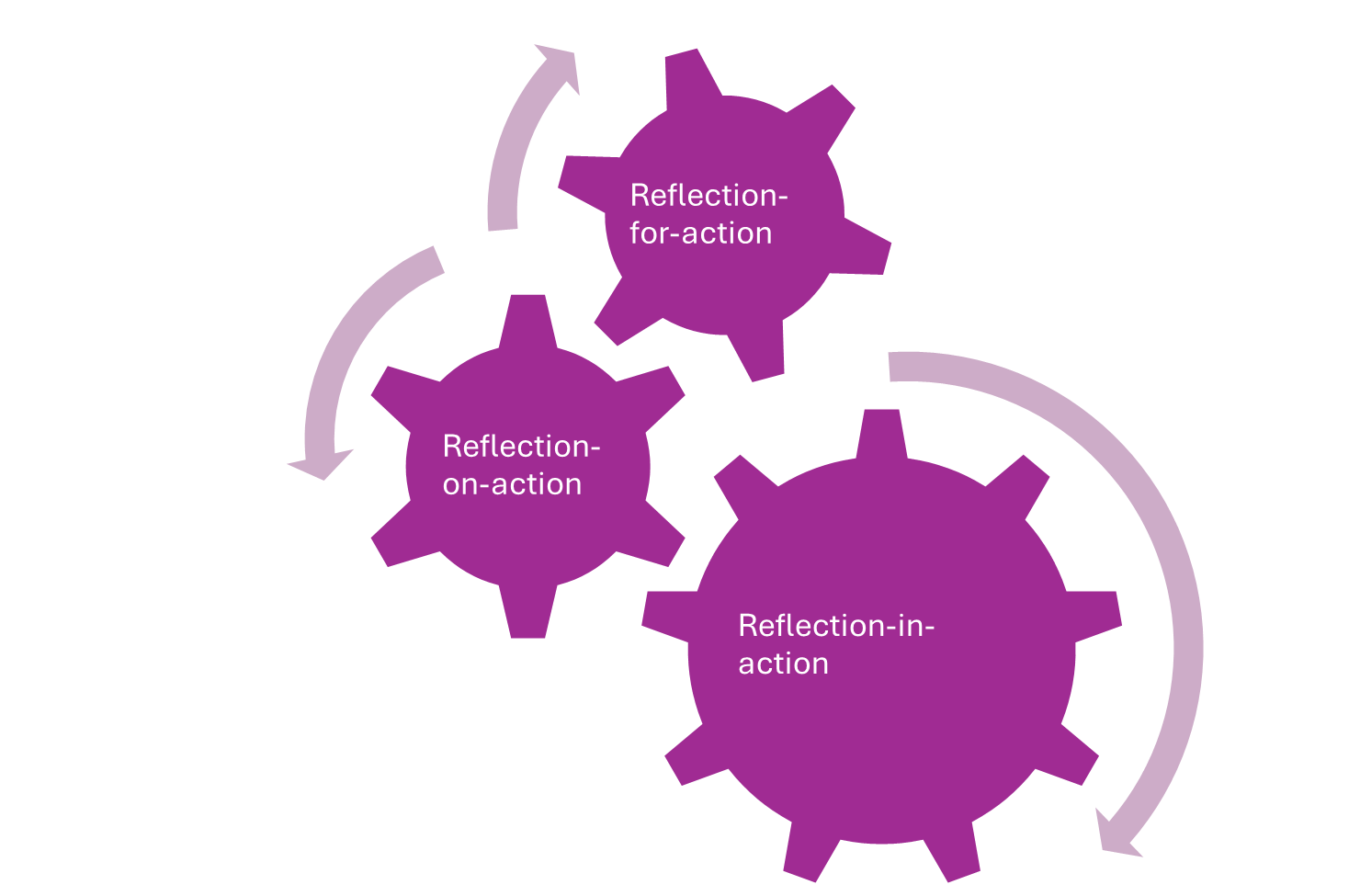
A striking finding is that not all lecturers consistently engaged in reflective practices, and there wasn’t clear evidence of a shared, structured reflective culture across the teaching team. Some lecturers could articulate a teaching philosophy, but this didn’t always translate into a repeatable reflection cycle (before, during, and after teaching). I  framed this using Dewey and Schön’s well-known reflection stages:

  • Reflection-for-action (before teaching): planning with intention
  • Reflection-in-action (during teaching): adjusting as it happens
  • Reflection-on-action (after teaching): reviewing to improve next time

Even where lecturers were clearly committed and experienced, reflection could still become fragmented, more like “minor tweaks” than a consistent, evidence-informed practice.

The real engine of reflection: lecturer-student interaction

Interaction isn’t just a teaching technique – it’s a reflection tool.

Student questions, live confusion, moments of silence, a sudden “Ohhh!” – these are data. In the study, the clearest examples of reflection happening during teaching came from lecturers who intentionally built in interaction (eg questioning strategies, pausing for problem-solving).

One example stands out: Denise’s in-class quiz is described as the only instance that embodied all three reflection components using student responses to gauge understanding, adapting support during the activity, and feeding insights forward into later planning.

Why this matters right now in UK HE

UK higher education is navigating increasing diversity in student backgrounds, expectations, and prior learning alongside sharper scrutiny of teaching quality and inclusion. In that context, reflective teaching isn’t “nice-to-have CPD”; it’s a way of ensuring our teaching practices keep pace with learners’ needs, not just disciplinary content.

The paper doesn’t argue for abandoning lectures. Instead, it shows how reflective practice can help lecturers adapt within lecture-based structures especially through purposeful interaction that shifts students from passive listening toward more active/constructive engagement (drawing on engagement ideas such as ICAP).

Three “try this tomorrow” reflective moves (small, practical, high impact)

  1. Plan one interaction checkpoint (not ten). Add a single moment where you must learn something from students (a hinge question, poll, mini-problem, or “explain it to a partner”). Use it as reflection-for-action.
  1. Name your in-the-moment adjustment. When you pivot (slow down, re-explain, swap an example), briefly acknowledge it: “I’m noticing this is sticky – let’s try a different route.” That’s reflection-in-action made visible.
  1. End with one evidence-based note to self. Not “Went fine.” Instead: “35% missed X in the quiz – next time: do Y before Z.” That’s reflection-on-action you can actually reuse.

Questions to spark conversation (for you or your teaching team)

  • Where does your teaching philosophy show up most clearly: content coverage, student confidence, relevance, or interaction?
  • Which “data” do you trust most: NSS/module evaluation, informal comments, in-class responses, attainment patterns and why?

If your programme is team-taught, what would a shared reflective framework look like in practice (so reflection isn’t isolated and inconsistent)?

If reflective teaching is the intention, this article is the nudge: make reflection visible, structured, and interaction-led, so adaptation becomes a habit, not a heroic one-off.

Dr Yetunde Kolajo is a Student Success Research Associate at the University of Kent. Her research examines pedagogical decision-making in higher education, with a focus on students’ learning experiences, critical thinking and decolonising pedagogies. Drawing on reflective teaching practice, she examines how inclusive and reflective teaching frameworks can enhance student success.


Leave a comment

It is not just about evaluation: the role of research in supporting widening participation

by Neil Raven

Much attention is now directed towards the role of evaluation in efforts to widening higher education participation. Indeed, the evaluation of interventions aimed at broadening HE access, and ensuring the success of those from under-represented groups once they are at university, is considered a priority by the Office for Students [OfS], (Blake 2022; OfS, 2023a; OfS, 2024).

Various guidance documents prepared by the HE regulator, both for individual higher education providers (OfS, 2023b), and Uni Connect, the government funded collaborative outreach programme (OfS, 2022), set out a rationale for this focus. ‘High quality evaluation,’ it is argued, ‘allows universities and colleges to understand the impact of their work to support students’, and to improve the effectiveness of this work (OfS, 2023a), and through sharing the findings of such investigations to ‘contribute to the wider evidence base’ (OfS, 2022, 12). In contrast, the role of research in widening participation [WP] receives far less attention and appears to be considered of less significance. Whilst ‘evaluation’ accumulates 42 references in the OfS’s advice to HE providers’ on their access and participation plans, research is mentioned 16 times (OfS, 2023b). More pointedly, the regulator’s guidance to Uni Connect partnerships states that ‘research is not one of the main aims or expected outcomes of funding’ (OfS, 2022, 13).

Yet, arguably, research has an equally important role to play in supporting and advancing the WP agenda. To appreciate this it is helpful to draw out the distinctions between research and evaluation. Perhaps the most fundamental of these relates to the broader remit that research has in ‘seeking new insights’ and making ‘new discoveries.’ Often this involves testing theories or hypotheses, and generating findings that have wider application (Anon, nd, np; Rogers, 2014). For some, research is viewed as ‘active and proactive’, whereas evaluation is ‘reactive’, in the sense of responding to an activity or practice (Anon, 2024, np).

Arguably, these distinct qualities mean that research has the potential to address a number of key WP challenges that remain unexplored in evaluations. For instance, providing insights into the reasons for the comparatively low rates of HE participation amongst particular groups of learners. These include young men from white, working class backgrounds, along with those taking vocational (applied general) courses and studying in further education colleges. All three are areas of current concern for those engaged in widening participation (Atherton and Mazhari, 2019; Raven, 2022; Raven, 2021).

In addition, it is by means of research that we can learn more about the longer-term impact of the pandemic and the cost of living crisis on the progression plans of those from more deprived neighbourhoods, as well as the reasons why some WP students appear more likely to drop out of university-level study. Research can also tell us about the post-graduation experiences of under-represented backgrounds – insights that are of central importance in presenting the case for HE.  Indeed, research can be viewed as complementary to evaluation. Research can provide insights and guidance on how a particular WP challenge can be addressed, with evaluation deployed to assess the effectiveness of the measures taken.

Whilst the OfS’s limited support (and funding) may explain some of the comparative neglect of research, the way much WP-related research (admittedly, this includes my own) has tended to be conducted and disseminated may also act as an impediment to recognising its true value. Therefore, besides calling on the OfS to acknowledge the role that research can play in supporting efforts to widen participation, I have five suggestions aimed at fellow researchers for enhancing the accessibility – and impact – of their work:

  • Share research findings with WP practitioners through talks and presentations, as well as more interactive workshops
  • Publish work in journals whose readership includes WP practitioners and policy makers
  • Explore opportunities to circulate findings in more widely read newsletters and e-bulletins
  • Engage directly with practitioners in exploring potential research topics
  • Consider the practical, real world application of research findings.

I would welcome readers’ views on these suggestions.

Neil Raven is an educational consultant and researcher in widening access. Contact him at neil.d.raven@gmail.com.

Acknowledgements – Thank you to Tony Hudson, Lewis Mates, Jessica Benson-Egglenton, Robin Webber-Jones and John Baldwin.