SRHE Blog

The Society for Research into Higher Education


2 Comments

Reflective teaching: the “small shifts” that quietly change everything

by Yetunde Kolajo

If you’ve ever left a lecture thinking “That didn’t land the way I hoped” (or “That went surprisingly well – why?”), you’ve already stepped into reflective teaching. The question is whether reflection remains a private afterthought … or becomes a deliberate practice that improves teaching in real time and shapes what we do next.

In Advancing pedagogical excellence through reflective teaching practice and adaptation I explored reflective teaching practice (RTP) in a first-year chemistry context at a New Zealand university, asking a deceptively simple question: How do lecturers’ teaching philosophies shape what they actually do to reflect and adapt their teaching?
What the study did

I interviewed eight chemistry lecturers using semi-structured interviews, then used thematic analysis to examine two connected strands: (1) teaching concepts/philosophy and (2) lecturer-student interaction. The paper distinguishes between:

  • Reflective Teaching (RT): the broader ongoing process of critically examining your teaching.
  • Reflective Teaching Practice (RTP): the day-to-day strategies (journals, feedback loops, peer dialogue, etc) that make reflection actionable.

Reflection is uneven and often unsystematic

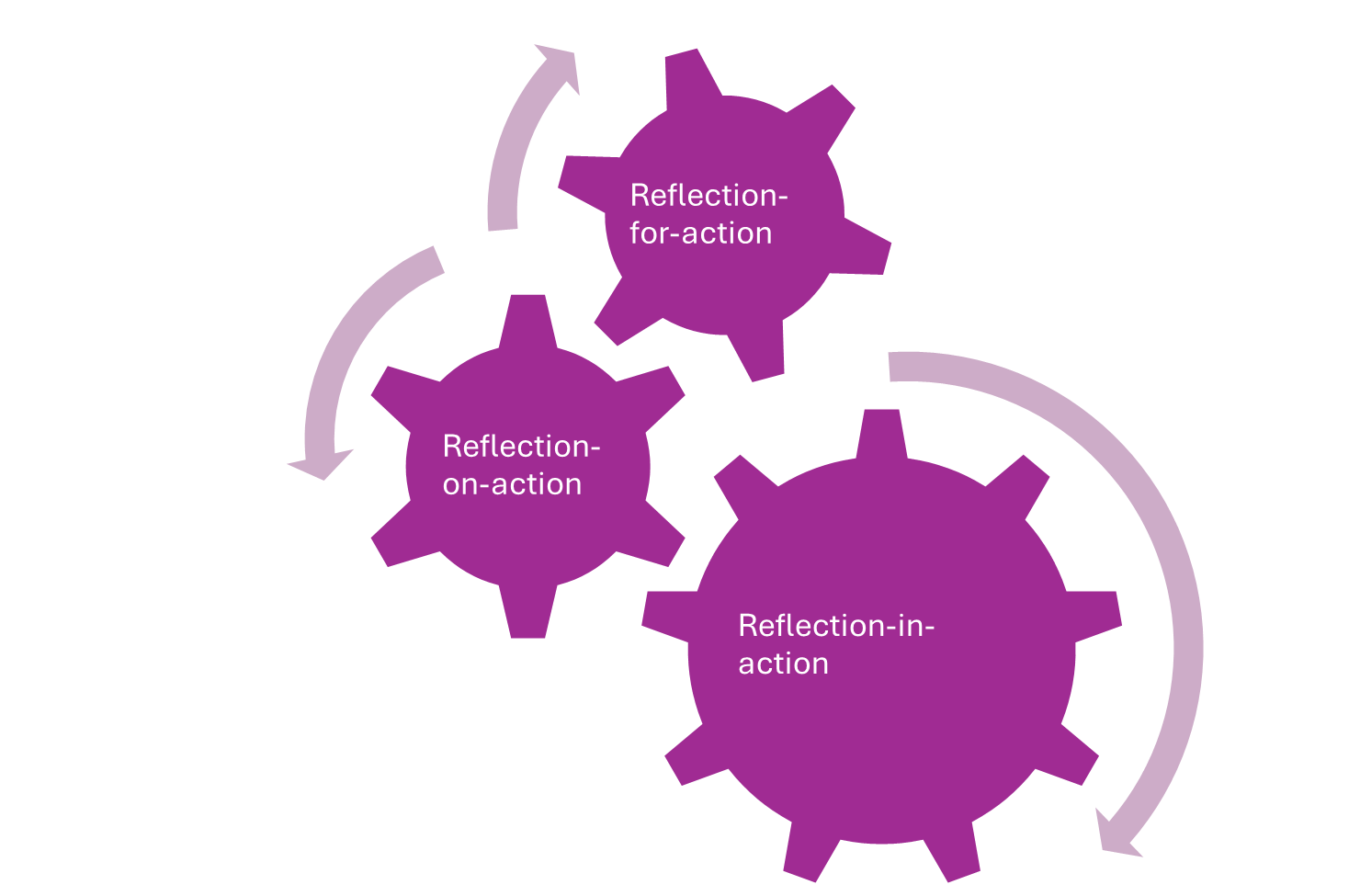
A striking finding is that not all lecturers consistently engaged in reflective practices, and there wasn’t clear evidence of a shared, structured reflective culture across the teaching team. Some lecturers could articulate a teaching philosophy, but this didn’t always translate into a repeatable reflection cycle (before, during, and after teaching). I  framed this using Dewey and Schön’s well-known reflection stages:

  • Reflection-for-action (before teaching): planning with intention
  • Reflection-in-action (during teaching): adjusting as it happens
  • Reflection-on-action (after teaching): reviewing to improve next time

Even where lecturers were clearly committed and experienced, reflection could still become fragmented, more like “minor tweaks” than a consistent, evidence-informed practice.

The real engine of reflection: lecturer-student interaction

Interaction isn’t just a teaching technique – it’s a reflection tool.

Student questions, live confusion, moments of silence, a sudden “Ohhh!” – these are data. In the study, the clearest examples of reflection happening during teaching came from lecturers who intentionally built in interaction (eg questioning strategies, pausing for problem-solving).

One example stands out: Denise’s in-class quiz is described as the only instance that embodied all three reflection components using student responses to gauge understanding, adapting support during the activity, and feeding insights forward into later planning.

Why this matters right now in UK HE

UK higher education is navigating increasing diversity in student backgrounds, expectations, and prior learning alongside sharper scrutiny of teaching quality and inclusion. In that context, reflective teaching isn’t “nice-to-have CPD”; it’s a way of ensuring our teaching practices keep pace with learners’ needs, not just disciplinary content.

The paper doesn’t argue for abandoning lectures. Instead, it shows how reflective practice can help lecturers adapt within lecture-based structures especially through purposeful interaction that shifts students from passive listening toward more active/constructive engagement (drawing on engagement ideas such as ICAP).

Three “try this tomorrow” reflective moves (small, practical, high impact)

  1. Plan one interaction checkpoint (not ten). Add a single moment where you must learn something from students (a hinge question, poll, mini-problem, or “explain it to a partner”). Use it as reflection-for-action.
  1. Name your in-the-moment adjustment. When you pivot (slow down, re-explain, swap an example), briefly acknowledge it: “I’m noticing this is sticky – let’s try a different route.” That’s reflection-in-action made visible.
  1. End with one evidence-based note to self. Not “Went fine.” Instead: “35% missed X in the quiz – next time: do Y before Z.” That’s reflection-on-action you can actually reuse.

Questions to spark conversation (for you or your teaching team)

  • Where does your teaching philosophy show up most clearly: content coverage, student confidence, relevance, or interaction?
  • Which “data” do you trust most: NSS/module evaluation, informal comments, in-class responses, attainment patterns and why?

If your programme is team-taught, what would a shared reflective framework look like in practice (so reflection isn’t isolated and inconsistent)?

If reflective teaching is the intention, this article is the nudge: make reflection visible, structured, and interaction-led, so adaptation becomes a habit, not a heroic one-off.

Dr Yetunde Kolajo is a Student Success Research Associate at the University of Kent. Her research examines pedagogical decision-making in higher education, with a focus on students’ learning experiences, critical thinking and decolonising pedagogies. Drawing on reflective teaching practice, she examines how inclusive and reflective teaching frameworks can enhance student success.


Leave a comment

Psychological Safety in the Doctoral Context

by Jayne Carruthers

The doctorate is a subjective experience demanding the re-evaluation of ways of thinking, the navigation of intense emotions, and the adaptation of behaviours by the candidate to achieve new learning goals, transforming the candidate from a consumer to a creator of knowledge. Candidates often face uncertainty and enter a state of liminality during this process, feeling caught between old beliefs and new insights, which can lead to discomfort and feeling ‘stuck’. To navigate this liminal space, candidates benefit from a change in perspective supported by transformative learning. While much of the focus in doctoral support is on the candidate avoiding negative experiences during this process, there is limited attention given to the candidate’s role of self-awareness and self-management. Reflexivity provides one such option to consider.

Reflexivity is a cognitive, or thinking, process that enables individuals to move beyond simple reflection, fostering self-awareness and exploring different options for progress. While candidates have demonstrated its usefulness in understanding their doctoral journeys, further research is needed on initiating and sustaining this process independently. This ability to learn and develop autonomously is essential, as doctoral programs require candidates to show evidence of becoming independent researchers. In organisational literature, reflexivity has been demonstrated to enhance information processing, helping employees understand what, why, and how of learning and change. It enables adjustments in both task execution and personal approach. Moreover, team psychological safety has been demonstrated to be crucial for effective team reflexivity. However, variations in terminology and definitions related to psychological safety limit the extension of this construct beyond the organisational context.

A body of conceptual research adopting a Theoretical Integrated Review (TIR) approach was conducted, with findings highlighting historical use, providing theoretical insights, and clarifying a generalised definition of psychological safety with relevance beyond the organisational setting. Psychological safety is an internal process that helps individuals manage distress, influencing their thoughts, feelings, and actions. It plays a crucial role in growth and development by connecting motivation and goal-directed behaviour, providing the opportunity for a generalised definition:

Psychological safety is a dynamic intrapsychic construct drawn on by individuals to mitigate actual or foreseen distress. The presence or absence of psychological safety is influenced by context, the individual’s existing psychological frames of reference, and current and future motives relating to an endeavour.

This understanding allows the absence or presence of psychological safety to be considered in broader contexts, including independent learning settings like doctoral programs. To explore this potential, a body of qualitative research was conducted with six volunteer PhD candidates enrolled at a regional Australian university awaiting feedback on their theses.

Using the vignette methodology technique to present short fictional scenarios regarding experiences of doctoral knowledge uncertainty, the researcher conducted semi-structured interviews to understand how doctoral candidates deal with knowledge uncertainty. This approach encouraged interviewees to discuss their experiences without the pressure of direct questions, facilitating open discussions about managing uncertainty. At the end of the interviews, findings from the conceptual research were shared, and feedback was gathered on their benefit as a basis for candidate support. The interviews were recorded, transcribed, and thematically analysed.

All six interviewees described experiences with knowledge uncertainty and agreed that the conceptual research findings on psychological safety could improve opportunities for candidate support and warranted further investigation. The analysis of the interviews revealed that the interviewees’ experiences of uncertainty stemmed from intrapersonal, interpersonal, and university governance-level interactions. While similarities existed based on stages in the doctoral program, no strong recurring theme of uncertainty emerged. Notably, the differences lay in how the interviewees discussed their experiences of uncertainty.

Some interviewees emphasised the importance of interpersonal support to help them progress:

… the Confirmation panel Chairperson insisted that I rework my research question … I found it confusing. I felt that I must have grossly mistaken something …. my supervisor just said, okay, well, rebuild methodology … I felt uncertain. But she was very encouraging and supportive … I got through the second time, no questions asked …                                                                                                                                                                                                 Interviewee Steve

… my methodology was underdeveloped … I was asked to resubmit this section to the confirmation panel … I was stressed about it having to be perfect because I thought failing would be the worst thing in the world.  … I remember that being a big thing … I was embarrassed, … an extra hurdle because no one else I knew needed to resubmit … my supervisors were empowering … they both said, redo what you need to … You’ll get through. You’re going to be okay.                                                                                                                                                                                                                                                 Interviewee Amy

Other interviewees’ narratives shifted from reflection to reflexivity, demonstrating self-awareness and developing metacognitive strategies to navigate their uncertainties.

So yeah, it was an unhappy period. It was a couple of months of really hating what I was, what I’d done to myself in choosing this particular topic…I just had to ride that wave, you know, think it through, think, really think about what I was doing and why I was doing it, what the product was, what the process was and what the result needed to be in the end. 

                                                                                                                                 Interviewee Julie

… a big part of my uncertainty was about paradigms … I couldn’t write my methodology. … I was just not convinced … if I can’t believe in these views about knowledge and reality, I can’t write about this stuff. So that was a hurdle …  I was sometimes reading without knowing what would come of it. … then it felt like, oh, this is it … what had been a major period of uncertainty had also been a cognitively shifting one that changed my perception of the world.                                                                                                                Interviewee Jack

The extracts illustrate how interviewees navigated uncertainties and liminal spaces, utilising various strategies to move forward. Some narratives show less use of self-awareness, relying on interpersonal support, while others reflect and use reflexivity as a proactive, independent approach to managing uncertainty.

Understanding psychological safety as a multi-dimensional construct and appreciating its demonstrated moderating effect on reflexivity in the workplace provides an opportunity for further investigation. The differences in interviewees’ narratives offer valuable insights regarding reflexivity and the doctoral experience of uncertainty, collectively establishing a basis for exploring psychological safety in the doctoral context.

Jayne Carruthers is a PhD candidate in SORTI, a research centre based in the School of Education at The University of Newcastle, Australia, where she works as a Research Assistant. With a background in Adult Education and Positive Psychology, she has a well-developed interest in fostering autonomous learners. Her PhD research explores psychological safety within doctoral learning and development. Her recent publications include “Conveying the learning self to others: doctoral candidates conceptualising and communicating the complexion of development”


Leave a comment

When research becomes an intervention: Insights from the Student 2025 project

by Ria Bluck

Within higher education, targeted interventions are used to improve the student experience, engagement, and academic outcomes. These initiatives tend to focus on increasing a sense of belonging, students’ confidence in their learning activities, and enhancing attainment. In some instances, these interventions are specifically tailored to support student groups which are underrepresented in higher education or are more likely to face challenges within their academic experience.

The Student 2025 project is an innovative four-year longitudinal project which follows the undergraduate journey of 100 students at Nottingham Trent University (NTU). Designed to capture the intricacies of the student experience, the project gathers data through conducting interviews and surveys with each participant three times a year.

Interestingly, the Student 2025 project itself appears to mirror qualities of an intervention in its own right. In the most recent data collection, where many of our students were due to graduate, the research team explored whether their participation in Student 2025 had affected their experience at NTU in any way. Students told us that they thoroughly enjoyed taking part in the project and that their involvement had positively affected both their university experience and their personal development. While the positive effects of taking part in research are widely recognised, the extent of the benefits reported by Student 2025 participants was particularly noteworthy.

Development of self-reflection skills

Most students in the sample found that Student 2025 had given them a space to reflect on their time at NTU in a way that they would not have done without the project. Having dedicated time to reflect helped them to understand their skills development, progress, and achievement over the course of their undergraduate degree – encouraging them to take note and be proud of their work.

Students also shared that reflecting on their experience each term enabled them to identify areas where they were struggling or that could use improvement. This regular reflection allowed them to be critical about what they could do better and what support they would need to get there. Having consistent interviews, often with the same interviewer, also created a sense of accountability. It encouraged some students to make changes as a result of their reflections, leading them to take proactive steps to improve their university experience. Not only did Student 2025 give students the opportunity to self-reflect, it also facilitated the development of self-reflection skills, helping them to do this more effectively.

Developing confidence

Several students shared that Student 2025 had considerably boosted their confidence. For some, this sense of confidence related to their overall experience at NTU, while for others, it centred on their social engagement and future prospects.

One student explained that they had joined Student 2025 to actively develop their public speaking skills. By their final term at university, they reported feeling much more comfortable speaking with others than when they first started at NTU. As well as this, a few students had gained confidence in using Microsoft Teams to communicate with others. One student highlighted that taking part in regular online interviews for Student 2025 had helped them to get used to this type of environment, boosting their confidence in their post-university job search.

An increased sense of belonging

A large focus of Student 2025 was to gain a deeper understanding of how students experience a sense of belonging at university and how this affects their undergraduate journey. It was therefore particularly interesting that students felt they had gained a greater sense of belonging at NTU as a result of their engagement with the project.

Participants told us that the project had made them feel more connected to the university, that they were a part of something meaningful, and were valued by NTU. A significant factor in this was how the project facilitated students in feeling heard and provided them with the opportunity to share impactful feedback. The team also worked hard to keep participants in the loop with the progress and impact of the project for this reason.

“Student 2025 has also added to my feelings of belonging and being valued at NTU, all in all a positive experience, I’m grateful to have taken part”.

An enhanced level of support

Many students in this project highlighted the therapeutic benefits of talking to someone who had no connection to their course or personal circumstances. Having an unbiased contact at the university provided a non-judgemental space where students could freely discuss their personal challenges in great detail.

Despite being experienced researchers, we participated in additional training, such as meeting with Student Support Services staff to learn how to best support students in distress. We guided students to think deeply about their experiences, signposting them to support where we felt it was necessary. Some students told us that, because of Student 2025, they had been able to reach out to services that they were previously unaware of – actively improving their access to NTU services, with the Student 2025 project acting as an extra layer of support.

How can the sector learn from Student 2025?

We anticipated that this project would produce a great number of impactful findings that would enhance our understanding of the undergraduate experience at NTU. What we did not anticipate was that the methodology itself would have such an impact on the students’ university journey.

The impact of Student 2025 on participants has exceeded expectations, with some sharing how it has been the highlight of their university experience and feeling extremely proud of their involvement. They have also developed a strong sense of care for the project and its potential impact, feeling that they have taken the time to advocate for students at NTU and have helped in enacting positive change for students like them.

“This has been a highlight of my university experience. It has helped me in becoming more reflective as an individual and recognise how much I have progressed. Taking part in this has made me proud of myself and I am grateful for the opportunity.”

The higher education sector could learn a great deal from the Student 2025 project, and the way it has enhanced the university experience for these students.

Longitudinal research is resource-intensive, but using elements of its methodology within interventions could replicate its benefits without the need for further extensive research. For instance, this could serve as an opportunity to reconsider how personal tutoring is used on courses, prioritising reflective activities that foster both a space for personal development and course feedback. Or how mentorship programmes could be introduced to enhance the experience of specific student groups.

It is clear that students value consistent and personalised interactions with staff members throughout their university journey. Finding ways to embed this could enhance student confidence, a sense of belonging, and self-reflection – as has been reported within the Student 2025 project.

Ria Bluck is an Educational Research and Evaluation Specialist at Nottingham Trent University with a breadth of experience exploring disparities in student experience. Her work has primarily focused on researching topics of wellbeing and inclusion in higher education, using student voice to enhance the experiences of students from diverse backgrounds.

Kelly Coate


Leave a comment

Reflective teaching in higher education

By Kelly Coate

Those of us who research higher education, and universities in particular, are endlessly offered rich sources of data from one of the most enduring and fascinating institutions in the world. Higher education is an unusual site of research, given the wide range of disciplines that can be employed and the diversity of approaches that can be taken. It is unusual for other reasons too: here in the SRHE we continue to develop as a very strong community of higher education specialists, but we know that almost anyone who works in academia might fancy trying their hand at doing higher education research, most likely in their classrooms but increasingly with other groups such as administrators or managers. Some of us may despair at the lack of knowledge and depth that higher education research ‘amateurs’ bring to bear on the field, but others of us encourage novices to get involved, mainly through the postgraduate programmes in academic practice that have become embedded in many institutions. Therefore another distinctive feature of higher education research is that we speak to many audiences through our publications. Mainly – as in common with other disciplinary specialists – we like to talk to each other, but our books and articles are increasingly used in those academic practice programmes just mentioned, and so a wide range of other disciplinary experts are now engaging with our work. Continue reading