


by Yetunde Kolajo
If you’ve ever left a lecture thinking “That didn’t land the way I hoped” (or “That went surprisingly well – why?”), you’ve already stepped into reflective teaching. The question is whether reflection remains a private afterthought … or becomes a deliberate practice that improves teaching in real time and shapes what we do next.
In Advancing pedagogical excellence through reflective teaching practice and adaptation I explored reflective teaching practice (RTP) in a first-year chemistry context at a New Zealand university, asking a deceptively simple question: How do lecturers’ teaching philosophies shape what they actually do to reflect and adapt their teaching?
What the study did
I interviewed eight chemistry lecturers using semi-structured interviews, then used thematic analysis to examine two connected strands: (1) teaching concepts/philosophy and (2) lecturer-student interaction. The paper distinguishes between:
- Reflective Teaching (RT): the broader ongoing process of critically examining your teaching.
- Reflective Teaching Practice (RTP): the day-to-day strategies (journals, feedback loops, peer dialogue, etc) that make reflection actionable.
Reflection is uneven and often unsystematic
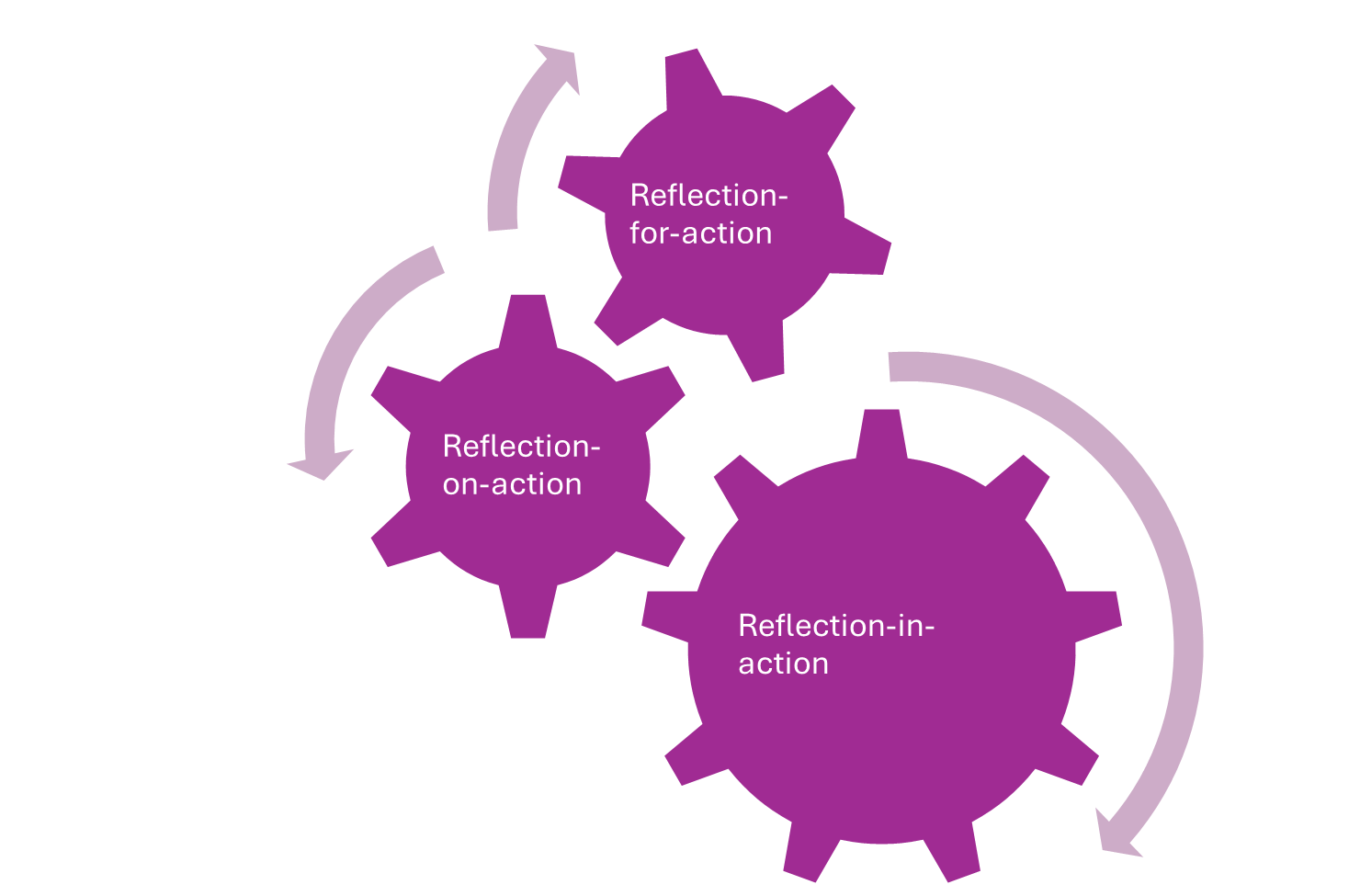
A striking finding is that not all lecturers consistently engaged in reflective practices, and there wasn’t clear evidence of a shared, structured reflective culture across the teaching team. Some lecturers could articulate a teaching philosophy, but this didn’t always translate into a repeatable reflection cycle (before, during, and after teaching). I framed this using Dewey and Schön’s well-known reflection stages:
- Reflection-for-action (before teaching): planning with intention
- Reflection-in-action (during teaching): adjusting as it happens
- Reflection-on-action (after teaching): reviewing to improve next time
Even where lecturers were clearly committed and experienced, reflection could still become fragmented, more like “minor tweaks” than a consistent, evidence-informed practice.
The real engine of reflection: lecturer-student interaction

Interaction isn’t just a teaching technique – it’s a reflection tool.
Student questions, live confusion, moments of silence, a sudden “Ohhh!” – these are data. In the study, the clearest examples of reflection happening during teaching came from lecturers who intentionally built in interaction (eg questioning strategies, pausing for problem-solving).
One example stands out: Denise’s in-class quiz is described as the only instance that embodied all three reflection components using student responses to gauge understanding, adapting support during the activity, and feeding insights forward into later planning.
Why this matters right now in UK HE
UK higher education is navigating increasing diversity in student backgrounds, expectations, and prior learning alongside sharper scrutiny of teaching quality and inclusion. In that context, reflective teaching isn’t “nice-to-have CPD”; it’s a way of ensuring our teaching practices keep pace with learners’ needs, not just disciplinary content.
The paper doesn’t argue for abandoning lectures. Instead, it shows how reflective practice can help lecturers adapt within lecture-based structures especially through purposeful interaction that shifts students from passive listening toward more active/constructive engagement (drawing on engagement ideas such as ICAP).
Three “try this tomorrow” reflective moves (small, practical, high impact)
- Plan one interaction checkpoint (not ten). Add a single moment where you must learn something from students (a hinge question, poll, mini-problem, or “explain it to a partner”). Use it as reflection-for-action.
- Name your in-the-moment adjustment. When you pivot (slow down, re-explain, swap an example), briefly acknowledge it: “I’m noticing this is sticky – let’s try a different route.” That’s reflection-in-action made visible.
- End with one evidence-based note to self. Not “Went fine.” Instead: “35% missed X in the quiz – next time: do Y before Z.” That’s reflection-on-action you can actually reuse.
Questions to spark conversation (for you or your teaching team)
- Where does your teaching philosophy show up most clearly: content coverage, student confidence, relevance, or interaction?
- Which “data” do you trust most: NSS/module evaluation, informal comments, in-class responses, attainment patterns and why?
If your programme is team-taught, what would a shared reflective framework look like in practice (so reflection isn’t isolated and inconsistent)?

If reflective teaching is the intention, this article is the nudge: make reflection visible, structured, and interaction-led, so adaptation becomes a habit, not a heroic one-off.
Dr Yetunde Kolajo is a Student Success Research Associate at the University of Kent. Her research examines pedagogical decision-making in higher education, with a focus on students’ learning experiences, critical thinking and decolonising pedagogies. Drawing on reflective teaching practice, she examines how inclusive and reflective teaching frameworks can enhance student success.

January 13, 2026 at 10:00 pm
In 2008 I left a lecture thinking “I just told the students this would be my last lecture: what was I thinking?”. I then spent 7 years revising my teaching approach, not by reflecting, but by formal training. Academics devise ever more complex qualifications for others but avoid the most basic obvious ones for themselves, in how to teach. We don’t say to any other profession “You don’t needed to be formally trained or tested, just give it a go and reflect”, so why do we do that with academics? https://blog.tomw.net.au/2008/08/my-last-lecture.html
January 14, 2026 at 8:36 am
Thank you for sharing this experience and for the link. I think you raise an important and often under-acknowledged point about the role of formal pedagogical training in higher education. I agree that no other profession would consider it acceptable to rely solely on “giving it a go and reflecting,” and I share your concern about the historical undervaluing of teaching expertise in academia. My intention in writing about “small shifts” was to speak to what happens alongside and after training particularly for academics who are already qualified, experienced, and working in complex, time-pressured environments. In those contexts, reflective practice functions less as remediation and more as professional calibration: a way of noticing drift, surfacing assumptions, and responding thoughtfully to changing student needs. In many professions formal training, assessment, and reflective practice coexist. Reflection is not an alternative to standards; it is one of the mechanisms through which standards are sustained.